"Will a man rob God?" is preached as an indictment of anyone who skips the tithe. In its own setting it is a covenant-lawsuit charge against Israel under the Mosaic tithe system — and transplanting it onto New Covenant giving carries far less warrant than its sharpness suggests.
"Bring the whole tithe... test Me now in this" is the standard proof text for tithing as a binding New Covenant obligation. The question is not whether Malachi means what he says, but to whom it was said, under which covenant, and whether those stipulations transfer unchanged.
God fed two million people in a desert for forty years, and Deuteronomy says the point was never the food. The wilderness was a curriculum, and the manna was the first lesson.
Abraham said it on the way up the mountain without knowing what he was saying. Paul picks up the same verb in Romans 8 and finishes the sentence - and the two texts together make the strongest argument in Scripture for trusting God with anything smaller.
God announced a drought, then sent His prophet to be fed by unclean birds and a starving Gentile widow - in Baal's home territory, during the exact crisis Baal was supposed to prevent.
Jesus does not tell worried people to cheer up. He builds a case - from birds, from wildflowers, from what a Father knows - and Peter later tells you what to physically do with the worry.
The most familiar psalm in the Bible is also the most personal claim anyone in the Old Testament ever made about God - and underneath the pastoral imagery is the Exodus.
The God who made everything did not walk away from it. Scripture's claim is not that God started the world but that He is still holding it - and still feeding it, one day at a time.
Isaiah 40 answers a complaint from people who thought God had lost track of them - and the answer is a tour of the night sky. Creation doctrine turns out to be pastoral care.
Scripture claims the sky is making an argument, that everyone has heard it, and that this leaves the whole human race without a defense. It is a bold claim about what a person already knows before anyone hands them a Bible.
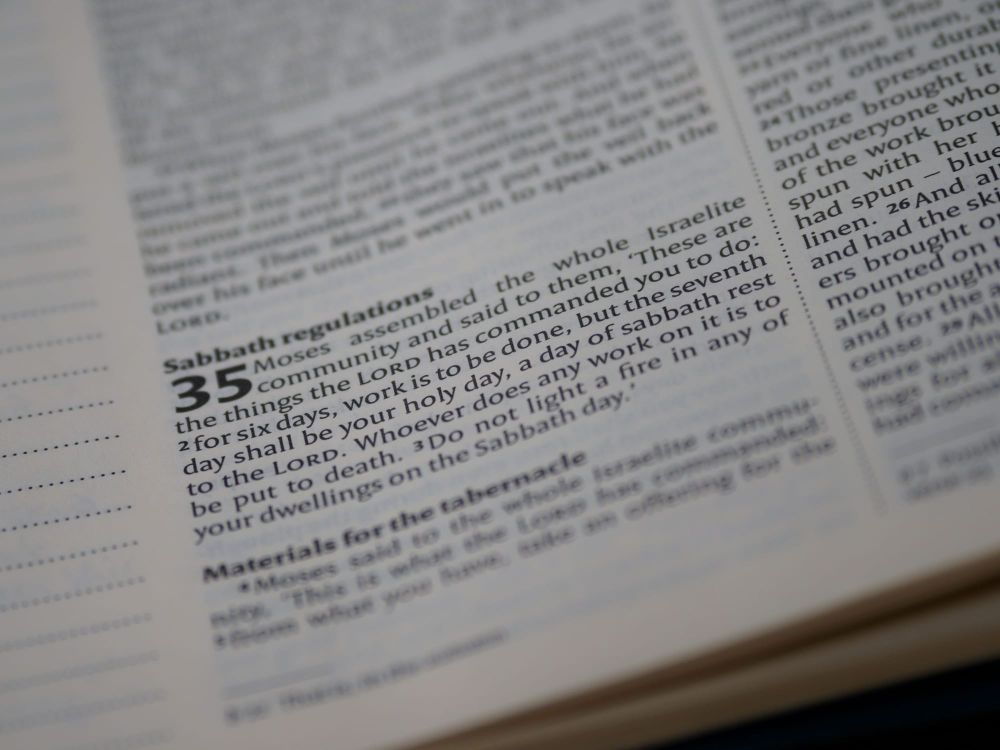
The first thing God ever called holy was not a place, a person, or an object. It was a day. Genesis 2:1-3 is the shortest paragraph in the creation account and the one most often skipped.
Isaiah says God stretched out the heavens with no one beside Him. The New Testament says all things were made through the Son. The objection is real, the texts are not in tension, and one popular Christian answer should be retired.
The doctrines of election and predestination represent some of the most discussed and debated topics in all of Christian theology.
No created being, force, or material existed before or apart from God's creative act. The Father wills, the Son executes (John 1:3; Colossians 1:16), and the Spirit animates (Genesis 1:2; Psalm 104:30). Creation is a Trinitarian act from beginning to end.
Every ideology answers the question of what makes a human being valuable, and many answers have ended in dehumanization. Scripture grounds dignity in the image of God — universal, non-negotiable, and inalienable regardless of race, age, ability, status, or moral performance.
'I can do all things through Christ who strengthens me' is widely quoted on merchandise, tattoos, and social media as a guarantee that Christ supplies strength for any goal. In popular use, this verse functions as a promise about outcomes.
Truthfulness is theology before it is etiquette. The God of Scripture cannot lie; the devil is the father of lies and has no truth in him. Every act of speech takes a side — and integrity is truth's structural form, the undivided person who is the same in every room.
The claim that Allah was the moon god of pre-Islamic Arabia is vivid, memorable, and weaker than its confidence suggests — which matters, because it is where every Muslim rebuttal begins. This study takes the evidence apart and grades it: what is load-bearing, and what is not.
Both traditions affirm a real, invisible order of beings with a chief adversary who tempts, deceives, and faces judgment. On the surface, jinn and demons look like one category with two labels. They are not — the two accounts differ at the root, in what these beings are.
Most arguments for the Trinity are cumulative. A smaller, sharper category exists: scenes where all three persons appear at once, named together, doing distinguishable things in a single breath — the texts a God who merely changes masks cannot explain.
Israel confessed one God for fifteen centuries without confessing three persons. The Old Testament does not teach the Trinity the way the New does — it does something more interesting: it leaves the door open where a strict unitarian monotheism would have nailed it shut.
The Watch Tower teaches an impersonal active force, something like electricity — and it has a real argument, since you do not pour out a person. Grammar settles less than either side thinks. What decides it is the phrase "another Helper," and the things only persons do.
Taught as a puzzle to be managed, the Trinity is inert. The apostles handle it differently: the three persons appear most often in descriptions of how a person actually gets saved, each doing what the others do not — remove any one and there is no salvation left to describe.
The claim that bishops voted the Trinity into existence at Nicaea in AD 325 has a checkable shape — and fails at every point that can be checked. Justin Martyr was writing triadic baptismal formulas 170 years earlier. What Nicaea actually did is more interesting than the myth.
Almost every objection to the Trinity is a version of one mistake: collapsing what something is into who someone is. One divine nature, three divine persons. Name that distinction and the standard objections — three gods, a dying God, the Father being greater — answer themselves.
In recent decades the question has taken on new urgency because of movements that ordain modern-day "apostles" and "prophets" with governing authority over networks of churches, sometimes claiming fresh revelation on par with, or supplementary to, the Scriptures the first apostles left behind.
This two-part series works through what Scripture actually says about them, passage by passage, and where the popular picture has drifted from the text.
The Bible assumes a populated universe. Alongside the world we can see, Scripture describes an entire order of created beings — messengers, burning ones, living creatures, archangels, thrones, dominions, rulers and authorities — made by and ranked under God.
Most people assume Satan fell and took a third of the angels with him, and that those angels are the demons. It is tidy, and it is not what Scripture says. The answer comes from somewhere unexpected — four dense verses before the Flood that most readers skim on the way to Noah.
"Have You come to torment us before the time?" The demons do not ask whether they will be judged — only about the schedule. They believe the sentence is already passed. Scripture agrees: chains now, the abyss at the appointed hour, and a fire prepared for the devil and his angels.
Paul's stack of terms in Ephesians 6 is usually read as rhetorical intensity. Every one of them is a jurisdictional word, inherited from a thread running back through Daniel to a passage in Deuteronomy explaining where the gods of the nations came from and what claim they had.
The Capernaum crowd was not amazed that a demon came out — exorcists were a known quantity. What stopped them cold was how: no incantation, no ritual, no appeal to a higher power. Two words. The Gospel exorcisms are Christological claims, not case studies in method.
Scripture never defines "demon." What it gives instead is vocabulary — goat demons, the scapegoat and the name in the lots, desert creatures, the night monster — words that English translations routinely render in ways that hide what is actually going on.
James reaches for the sharpest illustration available: the demons hold correct doctrine about God's oneness, and shudder. Right belief without works is not a lesser grade of faith — it is the kind of faith Scripture credits to beings who are certainly not saved.
Two distinct things travel under the name Kemetic spirituality: the historic religion of ancient Egypt, practiced for three and a half millennia around Ma'at, the Neteru, and the Ausarian drama — and the modern reconstructionist movement that seeks to recover and practice it.
Emerging from the Millerite movement and organized in 1863, Adventism affirms the Trinity, the deity of Christ, and salvation by grace — which is why it cannot be classed with Mormonism or the Watch Tower, and why its standing has to be argued on other grounds.
This post stands over the whole Biblical Context series as its foundation. Every other post puts one dislodged verse back where it belongs; this one asks the prior question: by what right do we do that to the Bible at all? Peter says the harm falls first on the one twisting it.
In both Hebrew and Greek thought, a "name" was never merely a label for identification — it encompassed a person's reputation, authority, character, and standing.
The titles Son of God and Son of Man for Jesus are often simplified to mean divine and human, respectively. However, Scripture indicates that each title encompasses both dimensions. This six-part series examines key passages for each title and explores how they unite in one person.
The titles *Son of God* and *Son of Man* for Jesus are often simplified to mean divine and human, respectively. However, Scripture indicates that each title encompasses both dimensions. This six-part series examines key passages for each title and explores how they unite in one person.
The charge that the god of the Quran is the adversary's own work is old, and usually mishandled — most of the alleged parallels prove nothing at all. This study discards the empty ones and applies Scripture's actual test: Paul's warning about another Jesus and a different spirit.
This series works through the biblical case for the deity of Jesus Christ across eight posts, moving from the shape of the argument itself to the Old Testament foundations, the four Gospels, Acts, the epistles, Revelation, and finally the historic denials of the doctrine.
Showing 50 of 127 total posts
Stay up to date with curated collection of our top stories.