Who are the Seventh-day Adventists?
Emerging from the Millerite movement and organized in 1863, Adventism affirms the Trinity, the deity of Christ, and salvation by grace — which is why it cannot be classed with Mormonism or the Watch Tower, and why its standing has to be argued on other grounds.
The Seventh-day Adventist Church emerged from the Millerite movement of the 1840s and was formally organized in 1863. It reports over 23 million baptized members worldwide, operates one of the largest Protestant-style education and healthcare networks on earth (including Loma Linda University and thousands of schools and hospitals), and is headquartered in Silver Spring, Maryland, governed by a representative General Conference structure.
A classification note up front. Adventism is commonly described as a Protestant denomination, and its own 28 Fundamental Beliefs do affirm doctrines that define historic Christian orthodoxy: one God in three co-eternal Persons; the full deity, incarnation, sinless life, substitutionary death, bodily resurrection, and personal return of Jesus Christ; salvation by grace through faith in Christ; the Bible as the infallible and sufficient Word of God. Belief 2 states plainly: "There is one God: Father, Son, and Holy Spirit, a unity of three coeternal Persons" (see the official 28 Fundamental Beliefs). Those affirmations are real and are not disputed here — Adventism should never be described in the same terms as Mormonism or the Jehovah's Witnesses, which deny the deity of Christ outright.
But this study does not classify Seventh-day Adventism as a Christian denomination, and the reason is not the Sabbath. It is that the movement has added to Scripture — which is the one thing Scripture forbids doing to Scripture (Deuteronomy 4:2; Proverbs 30:5–6; Jude 3). Four matters carry that verdict:
- A closed canon, functionally reopened. The writings of Ellen G. White settle doctrine that Scripture does not settle.
- The investigative judgment, a doctrine found nowhere in the Bible, derived in 1844 to explain a failed prediction.
- Annihilation and soul sleep, which Scripture contradicts.
- Adventism as the end-time remnant, a claim Revelation makes of no organization.
The standard applied throughout is the one Adventism itself claims to hold: Scripture alone. If the Bible does not say it, it is not true, and it is not binding. The four points above are treated in detail in the companion study, Christianity vs Seventh-day Adventists; this post sets out the history and theology from Adventism's own sources so the movement can be understood accurately before it is weighed.
Historical Origins
The Millerite Movement and the Great Disappointment (1831–1844)
William Miller (1782–1849), a Baptist lay preacher and farmer in upstate New York, concluded from the 2,300 "evenings and mornings" of Daniel 8:14 — interpreted as 2,300 years on the day-year principle and dated from Artaxerxes' decree of 457 BC — that Christ would return around 1843–44. He began preaching publicly in 1831, and the movement grew to perhaps 50,000–100,000 adherents across denominations.
After an initial revision, the date settled on October 22, 1844. When Christ did not appear, the movement collapsed in what is universally called the Great Disappointment. Hiram Edson, a Millerite, later described the anguish: they wept until the day dawned. Most Millerites abandoned the expectation entirely.
It is worth pausing on what had just happened, because everything that follows is built on this moment. A date had been set from Scripture, proclaimed publicly, and falsified by events. Scripture supplies a plain test for that situation:
Deuteronomy 18:22 (NASB95): "When a prophet speaks in the name of the LORD, if the thing does not come about or come true, that is the thing which the LORD has not spoken."
From Disappointment to Doctrine (1844–1863)
A small group refused to conclude the date was wrong, and instead reinterpreted the event. On the morning of October 23, 1844, Hiram Edson reported an insight while crossing a cornfield: that the "sanctuary" cleansed in Daniel 8:14 was not the earth but the heavenly sanctuary, and that on that date Christ had entered its Most Holy Place to begin a new phase of ministry — the investigative judgment. This became the theological foundation of Adventism and the doctrine most unique to it.
Three other streams converged:
- The Sabbath. Joseph Bates, influenced by Seventh Day Baptists, argued that the seventh-day Sabbath remained binding and was central to end-time faithfulness. He persuaded the emerging group, including James and Ellen White.
- Conditional immortality. Under George Storrs's influence, the group adopted the view that the soul is not innately immortal, the dead sleep unconscious, and the finally impenitent are destroyed rather than eternally punished.
- Prophetic guidance. Ellen G. Harmon (later White) (1827–1915), a young Millerite from Portland, Maine, began reporting visions in December 1844 — the first confirming the Millerite path and encouraging the disappointed believers. Over seventy years, she reported some 2,000 visions and produced a very large body of writing.
Note the order of events. The date failed in October. The reinterpretation arrived the next morning. The visionary confirmation followed in December. The movement's foundational doctrine was not read out of Scripture and then found to fit the calendar; it was produced to rescue the calendar, and then secured by a prophetic voice.
The group organized formally, adopting the name Seventh-day Adventist in 1860 and establishing the General Conference in 1863 with about 3,500 members.
Ellen G. White and Institutional Growth
Ellen White's influence extended well beyond doctrine. An 1863 health vision launched Adventism's enduring health emphasis — vegetarianism, abstinence from alcohol and tobacco, exercise, and rest — which produced the Western Health Reform Institute (later Battle Creek Sanitarium under John Harvey Kellogg, whose brother's cereal enterprise grew from that work) and eventually a global hospital system. She also drove the church's commitment to education and to worldwide mission.
Her major works include Steps to Christ, The Desire of Ages, The Great Controversy, and Patriarchs and Prophets, organized around the Great Controversy motif — the cosmic conflict between Christ and Satan over God's character and government, which functions as Adventism's overarching narrative framework. That framework is itself worth noticing: the story that organizes Adventist theology is not a story Scripture tells in that form. It came through her.
Her role has been debated internally and externally. Adventism's official position is careful: her writings are "a continuing and authoritative source of truth" but are not an addition to the canon, and Scripture remains the test by which all teaching — including hers — is judged (Fundamental Belief 18, "The Gift of Prophecy"). Critics, including the work of Adventist scholar Desmond Ford in the 1970s–80s (on the investigative judgment) and Walter Rea (on literary borrowing in her writings), pressed hard on both points. Ford's 1980 challenge led to his loss of ministerial credentials — a sequence that says a good deal about which authority is functionally final when the two conflict.
Twentieth Century to Present
The 1955–56 conversations with evangelical leaders produced Questions on Doctrine (1957), which clarified Adventist positions on the deity of Christ, the completeness of the atonement at the cross, and salvation by grace — leading Walter Martin and Donald Barnhouse to reclassify Adventists as fellow Christians. Two qualifications belong with that history: the volume was contested within Adventism, where "historic Adventists" objected that their representatives had conceded positions the church did not hold; and the reclassification addressed the Trinity, Christology, and the atonement — it did not address or resolve the four matters listed at the top of this post. The 28 Fundamental Beliefs were adopted in 1980 (as 27) and expanded in 2005.
Sacred Texts and Authority
The formal position. Fundamental Belief 1 affirms the Bible as the written Word of God, given by divine inspiration, "the supreme, authoritative, and the infallible revelation of His will," and "the standard of character, the test of experience, the definitive revealer of doctrines, and the trustworthy record of God's acts in history." Adventism formally holds sola Scriptura and rejects the idea that any writing supplements the canon.
Ellen G. White and the "Spirit of Prophecy." Fundamental Belief 18 identifies the gift of prophecy as a mark of the remnant church, manifested in her ministry, and says her writings "speak with prophetic authority and provide comfort, guidance, instruction, and correction to the church." She described herself as "a lesser light to lead men and women to the greater light."
Where the two collide. The formal denial and the functional reality do not match, and the gap is the central issue in assessing Adventism. Ask which distinctives would survive if she had never written. The sanctuary doctrine and investigative judgment rest on her visionary confirmation of Edson's insight. The health message originates in her 1863 vision. The Great Controversy framework, the eschatological weight on the Sabbath, and the identification of the movement with Revelation's remnant all trace to her. Remove her and almost nothing distinctively Adventist remains.
A writing that is formally subordinate but practically decisive — that supplies the interpretive key to the very texts it is supposedly being tested by, and that cannot be contradicted without institutional cost — is functioning as canon whatever the statement of belief calls it. Scripture's own claim is that it is sufficient by itself, making the believer "adequate, equipped for every good work" (2 Timothy 3:16–17), that the faith was "once for all handed down" (Jude 3), and that God's climactic word has been spoken in the Son (Hebrews 1:1–2).
Two evidential matters are also fairly noted. Some of her early teaching was later abandoned — notably the "shut door" position that probation had closed for those outside the movement after 1844. And substantial literary dependence on prior authors was documented in the 1970s–80s by Walter Rea and in the church's own commissioned study of The Desire of Ages by Fred Veltman. Adventist responses point out that borrowing was common nineteenth-century practice and that she never claimed verbal inspiration; readers can weigh that, but it does not establish the prophetic claim, and the biblical test remains Deuteronomy 18:21–22 and Isaiah 8:20 — "To the law and to the testimony!"
Core Doctrines
Doctrines Adventism Confesses in Common with Historic Christianity
These are stated plainly because misrepresenting them would be dishonest, and anyone can check the published beliefs:
- The Trinity — "one God: Father, Son, and Holy Spirit, a unity of three coeternal Persons" (Belief 2). (Several nineteenth-century pioneers, including James White and Uriah Smith, held semi-Arian views; the denomination moved to full Trinitarianism in the twentieth century. Worth holding alongside the claim that the movement was raised up to restore neglected truth: its founding generation was wrong about the nature of the Son for decades.)
- The full deity and eternal pre-existence of Christ, His virgin birth, sinless life, miracles, substitutionary death, bodily resurrection, ascension, high-priestly ministry, and personal, literal, visible, premillennial second coming.
- The personality and deity of the Holy Spirit.
- Salvation by grace through faith in Christ, apart from works (Belief 10).
- Justification as God's declaring the believer righteous.
- Baptism by immersion upon profession of faith; the Lord's Supper as a memorial ordinance.
- Scripture's inspiration and authority.
That these are confessed is not in question. What is in question is whether an orthodox statement of faith survives what the system builds on top of it — and the pattern of Galatians 1:8–9 is that an addition to a sufficient gospel is decisive no matter how sound the rest of the confession.
The Seventh-day Sabbath
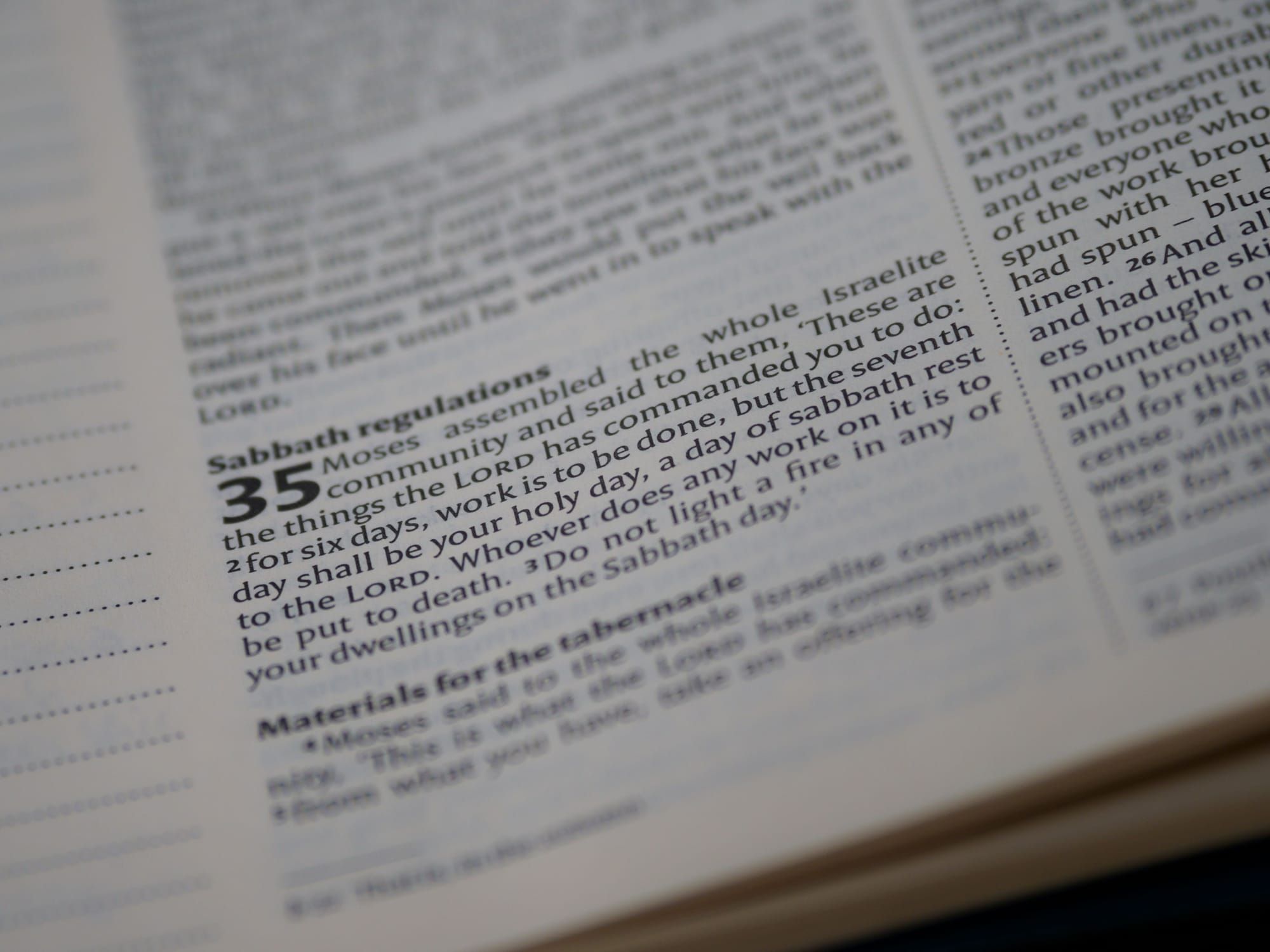
Adventists hold that the seventh day (Saturday) is the Sabbath instituted at creation (Genesis 2:1–3), codified in the moral law (Exodus 20:8–11), observed by Christ and the apostles, and never abrogated. Sunday observance is attributed to later ecclesiastical change rather than apostolic institution. Sabbath-keeping runs from sunset Friday to sunset Saturday and includes rest from labor and commerce.
Eschatologically, the Sabbath acquires additional weight: in Adventist end-time interpretation it becomes the seal of God, while enforced Sunday worship is associated with the mark of the beast (Revelation 13–14). Contemporary Adventist statements are careful to say that no one presently bears the mark, that sincere Christians worship on Sunday in good conscience, and that the issue becomes decisive only under a future coercive enforcement.
The day itself is a matter of conscience in Scripture (Colossians 2:16–17; Romans 14:5–6). The seal-and-mark overlay is another matter entirely: Revelation 13:16–17 ties the mark to commerce and to worship of the beast's image and says nothing at all about a day of worship. Attaching the wrath of God (Revelation 14:9–11) to a question the text never raises is an addition to Scripture, not an interpretation of it.
The Sanctuary and the Investigative Judgment
This is Adventism's most distinctive doctrine (Belief 24). It teaches that there is a literal sanctuary in heaven, of which the earthly was a type (Hebrews 8:1–5); that at His ascension Christ began His high-priestly ministry in its first apartment; and that in 1844, at the close of the 2,300-day prophecy, He entered the Most Holy Place to begin the second phase — a pre-advent investigative judgment that reviews the records of all who have professed faith, vindicating the genuine, blotting out their sins, and determining who is truly Christ's before He returns. It is understood as part of the final disposition of sin, typified by the Day of Atonement (Leviticus 16).
Adventists insist this does not undermine assurance: the judgment reveals rather than establishes the believer's standing, and the verdict rests on Christ's merits.
Hebrews says otherwise, and says it in the strongest terms available. Christ entered the holy place "once for all" — ἐφάπαξ (ephapax) — "having obtained eternal redemption" (Hebrews 9:11–12); the forerunner has already entered "within the veil" (Hebrews 6:19–20); "by one offering He has perfected for all time those who are sanctified" (Hebrews 10:14). And of the believer: "there is now no condemnation" (Romans 8:1); he "does not come into judgment, but has passed out of death into life" (John 5:24). Meanwhile Daniel 8 — the doctrine's source text — interprets itself as concerning Media-Persia and Greece (vv. 20–21) and the desecration of the earthly sanctuary, mentions no heavenly sanctuary, no judgment, and no 457 BC starting point, and never states the day-year equivalence that Numbers 14:34 and Ezekiel 4:6 state explicitly in their own texts.
The State of the Dead and Final Punishment
Adventism teaches conditional immortality: immortality belongs to God alone (1 Timothy 6:16) and is conferred on the redeemed at the resurrection. The dead are unconscious — "soul sleep" — awaiting resurrection (Ecclesiastes 9:5; Psalm 146:4; John 11:11–14). There is no immortal soul surviving death, and no conscious intermediate state.
Correspondingly, Adventists reject eternal punishment: after the millennium and final judgment, the wicked are raised, judged, and annihilated in the lake of fire — "the second death," an irreversible destruction (Malachi 4:1–3; Matthew 10:28; Revelation 20:14–15).
Scripture teaches neither. The dead are conscious — "absent from the body and... at home with the Lord" (2 Corinthians 5:8); "to depart and be with Christ, for that is very much better" (Philippians 1:23); "today you shall be with Me in Paradise" (Luke 23:43); the souls under the altar (Revelation 6:9–10); the rich man and Lazarus, both conscious immediately after death (Luke 16:22–25). And the punishment of the wicked is as lasting as the life of the righteous, because one word — αἰώνιος (aiōnios) — governs both in the same sentence: "These will go away into eternal punishment, but the righteous into eternal life" (Matthew 25:46; cf. Revelation 14:11; 20:10; Mark 9:48; 2 Thessalonians 1:9).
Eschatology and the Remnant
Adventist eschatology is historicist — reading Daniel and Revelation as unfolding across church history rather than confined to a future tribulation — and premillennial in a distinctive form: at the Second Coming the righteous are raised and taken to heaven, the earth lies desolate for the millennium with Satan bound to it, and after the thousand years the New Jerusalem descends, the wicked are raised and judged, and the earth is renewed.
Belief 13 identifies the remnant of Revelation 12:17 — those who "keep the commandments of God and hold to the testimony of Jesus" — with the movement that proclaims the three angels' messages of Revelation 14:6–12. Adventists have historically identified themselves with this remnant, while contemporary official statements clarify that God has faithful people in all communions.
The word in Revelation 12:17 is λοιπῶν (loipōn) — simply the rest of her offspring, an ordinary word describing believers under attack, not a title reserved for an organization chartered in 1863. Scripture's remnant is constituted by grace: "a remnant according to God's gracious choice" (Romans 11:5); "The Lord knows those who are His" (2 Timothy 2:19). And Christ's promise that the gates of Hades would not prevail against His church (Matthew 16:18) rules out any account in which the true church lapsed and had to be re-founded in the nineteenth century.
Lifestyle and the Health Message
Belief 22 (Christian Behavior) counsels abstinence from alcohol, tobacco, and unclean foods (Leviticus 11), and commends a vegetarian diet, exercise, rest, and modesty — the body being the temple of the Holy Spirit (1 Corinthians 6:19–20). Adventists also practice tithing and, in many congregations, an ordinance of foot-washing preceding the Lord's Supper (John 13:1–17).
The health emphasis has produced measurable results: Loma Linda, California, is one of the world's identified "Blue Zones," and the Adventist Health Studies have documented longevity advantages of roughly 7–10 years — findings widely cited in public-health literature. Scripture treats food as a matter of liberty rather than doctrine (1 Corinthians 8:8; Romans 14:17; Mark 7:19; 1 Timothy 4:1–5), so the practice is unobjectionable in itself. The issue is its origin: it entered the movement through a vision, not through the text.
Timeline
| Year | Event |
|---|---|
| 1831 | William Miller begins public preaching |
| Oct 22, 1844 | The Great Disappointment |
| Oct 23, 1844 | Hiram Edson's heavenly-sanctuary insight |
| Dec 1844 | Ellen Harmon's first vision |
| 1846 | Joseph Bates's Sabbath tract; James and Ellen White marry |
| 1860 | Name "Seventh-day Adventist" adopted |
| 1863 | General Conference organized (~3,500 members) |
| 1863 | Ellen White's health reform vision |
| 1866 | Western Health Reform Institute (later Battle Creek Sanitarium) |
| 1874 | First overseas missionary sent |
| 1888 | Minneapolis General Conference: righteousness by faith debate |
| 1915 | Ellen G. White dies |
| 1957 | Questions on Doctrine published after evangelical dialogues |
| 1980 | 27 Fundamental Beliefs adopted; Desmond Ford controversy |
| 2005 | 28th Fundamental Belief added |
Why Adventism Cannot Be Received as a Christian Denomination
The four counts, restated now that the system has been described:
1. The canon is closed. The faith was "once for all handed down to the saints" (Jude 3) — ἅπαξ, once, not to be repeated — and God's final word has been spoken in the Son (Hebrews 1:1–2). Scripture forbids addition in the plainest terms (Deuteronomy 4:2; Proverbs 30:5–6) and claims sufficiency for itself (2 Timothy 3:16–17; 1 Corinthians 4:6). Adventism denies that Ellen White's writings are canonical while allowing them to function as canon. Denying the title while exercising the function does not resolve the problem.
2. The investigative judgment is not biblical. It is not in Daniel 8, which interprets itself otherwise. It is not in Hebrews, which places Christ's entry into the Most Holy Place at His ascension, once for all, with those who are His perfected for all time (Hebrews 9:12; 10:14). It is not anywhere. It was derived to explain a failed date and secured by a vision.
3. Annihilation is not biblical. Nor is soul sleep. The dead are conscious, and the punishment of the wicked is described by the same word that describes the life of the righteous (Matthew 25:46).
4. The end-time remnant claim is not biblical. Revelation 12:17 speaks of the rest of the woman's offspring, not of a denomination; the remnant is constituted by grace (Romans 11:5), and Christ's church never lapsed (Matthew 16:18).
Counts two, three, and four are not independent errors. They exist because of count one. That is the shape of the problem, and it is why Adventism is best described as a nineteenth-century movement standing outside historic biblical Christianity rather than as a denomination within it.
Two closing points belong together. The verdict here is on a system, not on every person inside it — anyone who trusts Jesus Christ, God in the flesh, crucified and bodily risen, is saved by Him, and "the Lord knows those who are His" (2 Timothy 2:19). And that is precisely why the system must be named. No believer's standing is still under review. "By one offering He has perfected for all time those who are sanctified" (Hebrews 10:14); "there is now no condemnation for those who are in Christ Jesus" (Romans 8:1).
"To the law and to the testimony! If they do not speak according to this word, it is because they have no dawn." — Isaiah 8:20
Author

Raised in a Christian home, I came to faith later in life. A family crisis in 2019 drove me to study Scripture deeply, and by 2021 I answered my calling to ministry and teaching God's Word.
