Christianity vs Seventh-day Adventists
Mormonism and the Watch Tower deny the Trinity, deny the eternal deity of Christ, and redefine salvation. Seventh-day Adventism affirms all three.

There is a standard argument for treating Seventh-day Adventism as a Christian denomination, and it deserves to be stated at full strength before it is answered.
It runs like this. Mormonism and the Jehovah's Witnesses deny the Trinity, deny the eternal deity of Christ, and redefine salvation. Adventism affirms all three. Its published 28 Fundamental Beliefs confess "one God: Father, Son, and Holy Spirit, a unity of three coeternal Persons"; the full deity, virgin birth, sinless life, substitutionary death, bodily resurrection, and personal visible return of Jesus Christ; the personality and deity of the Holy Spirit; the Bible as the infallible and sufficient Word of God; and salvation "by grace through faith in Jesus... not by works" (see the official statement). Therefore, the argument concludes, the disagreements are family disagreements, and Adventism belongs inside the Christian fold.
That confession is real, and it is quoted here accurately rather than grudgingly. Adventism should never be caricatured as Arian or as works-based, and this study will not do so. But the conclusion does not follow from the premise, and the burden of what follows is to show why.
The Standard: What Scripture Says, and Nothing Added to It
The standard applied throughout is the one Adventism itself claims to hold: Scripture alone. If the Bible does not teach it, it is not true, it is not binding, and no amount of institutional sincerity can make it so. This is not a slogan borrowed from a tradition. It is Scripture's own repeated demand:
Deuteronomy 4:2 (NASB95): "You shall not add to the word which I am commanding you, nor take away from it, that you may keep the commandments of the LORD your God which I command you."
Proverbs 30:5–6 (NASB95): "Every word of God is tested; He is a shield to those who take refuge in Him. Do not add to His words Or He will reprove you, and you will be proved a liar."
Applied to Adventism, that standard yields four findings, and together they are why this study does not classify Seventh-day Adventism as a Christian denomination:
- The canon is closed, and Adventism has functionally reopened it. A nineteenth-century prophet's writings settle interpretive questions that Scripture does not settle.
- The investigative judgment is not in the Bible. It is not taught in Daniel, not taught in Hebrews, and not taught anywhere else. It was derived in 1844 to explain a failed date.
- Annihilation is not what Scripture teaches about the destiny of the wicked, and unconscious "soul sleep" is not what it teaches about the dead.
- The end-time remnant claim is not in Revelation. Revelation 12:17 does not describe a denomination organized in 1863.
Note the dependency running through all four. Counts two, three, and four are not independent errors that happened to accumulate. They exist because of count one. Remove the prophetic authority that settled them and the sanctuary doctrine has no exegetical foundation, the remnant identification has no anchor, and the whole 1844 framework collapses — which is precisely what Adventism's own scholars discovered when they tested it against the text.
Why an Orthodox Confession Does Not Settle the Question
The argument at the top of this study assumes that if a group's statement of faith is orthodox on God, Christ, and salvation, everything else is negotiable. Scripture does not work that way.
The Judaizers of Galatia confessed the God of Israel. They confessed Jesus as Messiah. They confessed His death and resurrection. Their doctrinal statement, had they written one, would have looked substantially orthodox. Paul did not weigh what they affirmed against what they added and call it a wash:
Galatians 1:8–9 (NASB95): "But even if we, or an angel from heaven, should preach to you a gospel contrary to what we have preached to you, he is to be accursed!"
What is added to the word of God does not sit politely alongside it. It reorganizes it. A system that adds a prophet, adds a judgment, and adds a remnant identity is not the apostolic faith plus some optional extras — it is a different framework that has absorbed the apostolic confession into itself.
On the 1955–56 dialogues. Much of the case for reclassifying Adventism rests on a historical event: conversations between Adventist leaders and the evangelicals Walter Martin and Donald Barnhouse, published as Questions on Doctrine (1957), after which both men moved Adventism from the cult category to the denominational one. The history is accurate and is not disputed here. Its authority is.
Three things should be said. First, a negotiated statement produced by a committee in 1957 does not settle a question of biblical truth; only Scripture does, and Scripture was not consulted at that table in the way it is being consulted here. Second, the volume was contested within Adventism itself, where a significant body of "historic Adventists" objected that the church's representatives had conceded positions the denomination did not actually hold — which means the document cannot be treated as a clean statement of Adventist belief. Third, and most importantly, the reclassification addressed the Trinity, the deity of Christ, and the nature of the atonement. It did not address, and did not resolve, the four counts above. The questions that matter here were left standing.
What Adventism Does Confess
These agreements are stated plainly, because misrepresenting them would be both dishonest and self-defeating — anyone can check the 28 Fundamental Beliefs in five minutes.
- The Trinity — one God in three co-eternal Persons (Matthew 28:19; 2 Corinthians 13:14)
- The full deity and eternal pre-existence of Christ (John 1:1; Colossians 2:9)
- The virgin birth, sinless life, and atoning substitutionary death (Isaiah 53:5–6; 1 Peter 2:24)
- The bodily resurrection of Christ (Luke 24:39; 1 Corinthians 15:3–8)
- The personality and deity of the Holy Spirit (Acts 5:3–4)
- Salvation by grace through faith in Christ, apart from works (Ephesians 2:8–9; Titus 3:5)
- The inspiration and authority of Scripture (2 Timothy 3:16–17)
- The literal, visible, personal return of Christ (Acts 1:11; Revelation 1:7)
- Baptism by immersion upon profession of faith
A historical note belongs here as well, and it cuts in a direction worth noticing. Several nineteenth-century Adventist pioneers — James White, Uriah Smith, J. N. Andrews — held semi-Arian views of Christ, denying His eternal pre-existence. The denomination later moved to full Trinitarianism, formalized in the twentieth century, and critiques that quote the pioneers as though they represented current teaching are out of date. But hold that fact alongside the claim that this movement was raised up to restore neglected truth: its founding generation was wrong about the nature of the Son for decades, throughout the years the prophetic gift was said to be operating among them, and the correction came late and slowly.
Count One: The Canon Is Closed
This is the root. Every other count grows from it.
What Adventism Teaches
Fundamental Belief 18 identifies the gift of prophecy as a mark of the remnant church and holds that it was manifested in Ellen G. White (1827–1915), whose writings "speak with prophetic authority and provide comfort, guidance, instruction, and correction." Adventism explicitly denies that her writings are an addition to the canon or a substitute for Scripture; she herself called them "a lesser light to lead men and women to the greater light."
The supporting arguments are these: prophecy is listed among ongoing gifts to the church (1 Corinthians 12:28; Ephesians 4:11); Joel anticipates prophesying in the last days (Joel 2:28–29; Acts 2:17); believers are told not to despise prophecy but to examine everything carefully (1 Thessalonians 5:19–21); prophets such as Agabus operated after Pentecost (Acts 11:28; 21:10–11); and "the testimony of Jesus is the spirit of prophecy" (Revelation 19:10) is read as identifying the prophetic gift as a mark of the true end-time church.
What Scripture Teaches
The faith was delivered once, finally, and completely.
Jude 3 (NASB95): "...contend earnestly for the faith which was once for all handed down to the saints."
The word is ἅπαξ (hapax, Strong's G530) — once, once for all, not to be repeated. Jude does not describe a deposit still being topped up in the nineteenth century. He describes a completed handover, and the only remaining task is contending for what was handed over.
Hebrews 1:1–2 (NASB95): "God, after He spoke long ago to the fathers in the prophets in many portions and in many ways, in these last days has spoken to us in His Son..."
The structure is deliberate: the prophetic era was fragmentary and preparatory; the speech in the Son is climatic and final. The writer sets the prophets in the past tense precisely to establish that God's definitive word has now been given. A movement that receives fresh normative guidance through a modern prophet has reversed the argument of Hebrews 1.
And Scripture is sufficient — not sufficient-plus-a-lesser-light:
2 Timothy 3:16–17 (NASB95): "All Scripture is inspired by God and profitable for teaching, for reproof, for correction, for training in righteousness; so that the man of God may be adequate, equipped for every good work."
If Scripture makes the believer adequate and equipped for every good work, then whatever a further prophetic voice supplies is by definition not needed — and if it is genuinely not needed, it cannot be permitted to settle doctrine. Paul's rule to the Corinthians is the operative one: "not to exceed what is written" (1 Corinthians 4:6).
(A note on method: Revelation 22:18–19 is the reflexive proof text here, but in its context it warns against tampering with the scroll of Revelation, which was not yet bound with anything. It illustrates the pattern God establishes at the close of a revelation; it is not by itself proof of a 66-book canon. The case above does not need it.)
The Formal Denial Does Not Match the Functional Reality
Adventism's formal position is careful, and if the formal position were the whole story there would be no count one. It is not the whole story.
Ask a simple diagnostic question: which Adventist distinctives would survive if Ellen White had never written? The sanctuary doctrine and the investigative judgment rest on a vision she reported confirming Hiram Edson's cornfield insight. The health message originates in her 1863 health vision. The eschatological weight assigned to the Sabbath, the Great Controversy framework that organizes the whole system, and the identification of the movement with Revelation's remnant all trace to her. Strip her out and there is very little distinctively Adventist left standing.
That is what functional canonicity looks like. A writing that is formally subordinate but practically decisive — that cannot be contradicted without institutional consequence, and that supplies the interpretive key to texts it is supposedly being tested by — is operating as canon regardless of what the statement of belief says about it. Denying the title while exercising the function does not resolve the problem; it obscures it. Scripture's own test is the reverse of this arrangement:
Isaiah 8:20 (NASB95): "To the law and to the testimony! If they do not speak according to this word, it is because they have no dawn."
The Prophetic Test
Scripture supplies a hard, empirical test for a prophetic claim, and it is not a gentle one:
Deuteronomy 18:21–22 (NASB95): "...When a prophet speaks in the name of the LORD, if the thing does not come about or come true, that is the thing which the LORD has not spoken. The prophet has spoken it presumptuously; you shall not be afraid of him."
Two documented matters bear directly on this. First, the "shut door" teaching: in her earliest visions Ellen White endorsed the view that probation had closed for those outside the movement in 1844 — a position the church later abandoned. A vision that confirmed the Millerite path immediately after the Millerite date failed is not a small evidentiary problem for a prophetic claim. Second, literary dependence: substantial borrowing from prior authors was documented in the 1970s and 1980s, notably by Walter Rea and in the church's own commissioned study of The Desire of Ages by Fred Veltman. Adventist responses note that borrowing was common nineteenth-century practice and that she never claimed verbal inspiration. Readers can weigh that response; what it cannot do is establish the claim in the first place.
The point of count one is not that Ellen White was a bad person or that her writings contain nothing true. The point is structural: a closed canon cannot accommodate a normative post-apostolic voice, and a movement built on one is not a denomination within biblical Christianity, whatever else it gets right.
Count Two: The Investigative Judgment Is Not in the Bible
What Adventism Teaches
Fundamental Belief 24 teaches a literal sanctuary in heaven (Hebrews 8:1–2) of which the earthly was a copy; that Christ began His high-priestly intercession at His ascension; and that in 1844 — at the close of the 2,300 evenings-and-mornings of Daniel 8:14, calculated as 2,300 years from the decree of Artaxerxes in 457 BC — He entered the second phase, the antitypical Day of Atonement, beginning a pre-advent investigative judgment. This judgment reviews the records of all who have professed faith, vindicates the genuine, blots out their sins, and determines who will be raised or translated at the Second Coming.
Supporting arguments: the Day of Atonement typology of Leviticus 16 requires an antitypical cleansing; judgment "begins with the household of God" (1 Peter 4:17); the court sits and books are opened before the Son of Man receives the kingdom (Daniel 7:9–14); "the hour of His judgment has come" is proclaimed as present (Revelation 14:7); Christ returns with reward already determined (Revelation 22:12); and the day-year principle is used elsewhere (Numbers 14:34; Ezekiel 4:6). Adventists insist the doctrine does not undermine assurance, since the verdict rests entirely on Christ's merits and the judgment reveals rather than creates one's standing.
What Scripture Teaches
Hebrews places Christ's entry into the true Most Holy Place at His ascension, not eighteen centuries later, and treats it as completed and unrepeatable:
Hebrews 9:11–12 (NASB95): "But when Christ appeared as a high priest of the good things to come, He entered through the greater and more perfect tabernacle... and not through the blood of goats and calves, but through His own blood, He entered the holy place once for all, having obtained eternal redemption."
The adverb is ἐφάπαξ (ephapax, Strong's G2178) — once for all, never to be repeated. The writer uses it and ἅπαξ (hapax) repeatedly of Christ's sacrifice and entry (Hebrews 7:27; 9:26, 28; 10:10). The forerunner has already entered within the veil (Hebrews 6:19–20) — and the veil is precisely the boundary of the Most Holy Place. Believers are therefore invited to enter the holy place now with confidence, since that veil was torn at the crucifixion (Hebrews 10:19–22; Matthew 27:51). And: "For by one offering He has perfected for all time those who are sanctified" (Hebrews 10:14).
Perfected already. For all time. There is no second phase pending.
The New Testament's language about the believer's judicial standing is likewise present tense and settled: "Therefore there is now no condemnation for those who are in Christ Jesus" (Romans 8:1); "he who hears My word and believes Him who sent Me has eternal life, and does not come into judgment, but has passed out of death into life" (John 5:24) — κρίσις (krisis, Strong's G2920), condemnatory judgment; "having been justified by faith, we have peace with God" (Romans 5:1); "their sins and their lawless deeds I will remember no more" (Hebrews 10:17). Believers do appear before the judgment seat of Christ (2 Corinthians 5:10; Romans 14:10–12) — but that is an assessment of works for reward, where one may suffer loss "yet so as through fire" and still be saved (1 Corinthians 3:12–15). It is not a review determining whether one's profession will stand.
On Daniel 8:14. The chapter interprets itself, and it does not interpret itself the way 1844 requires. Gabriel identifies the ram as Media-Persia and the goat as Greece (vv. 20–21). The vision's crisis is the little horn's desecration of the sanctuary and the cessation of the regular sacrifice (vv. 11–13), and the question asked is how long that desolation will last. The verb is צָדַק (tsādaq, Strong's H6663) — be put right, restored, vindicated — not the tāhēr used for the Day of Atonement cleansing in Leviticus 16. The 2,300 units are literally "evenings-mornings," most plausibly the sacrificial cycle. And nothing in the chapter mentions a heavenly sanctuary, an investigative judgment, or a starting point in 457 BC. The link to Artaxerxes' decree requires importing the seventy weeks of Daniel 9:24–27 — a separate vision with its own explicit terminus in the Messiah.
On the day-year principle. Numbers 14:34 and Ezekiel 4:6 each state the equivalence explicitly within the text — "a day for each year." Daniel 8 does not. Applying it there is an assumption imported into the passage, not a datum drawn from it.
On the origin of the doctrine. This deserves to be said directly, because it is the heart of count two. The investigative judgment was not derived from Scripture and then found to explain 1844. It was derived to rescue 1844. When Christ did not return on October 22, 1844, one group refused to conclude the date was wrong and instead reinterpreted the event. Hiram Edson's cornfield insight the following morning relocated the action from earth to heaven, and Ellen White's visionary endorsement sealed it. A doctrine that begins as the explanation of a failed prediction, and that requires a prophetic voice to secure it, has its origin outside the text — which is exactly what count one predicts.
The internal Adventist testimony is decisive here. Desmond Ford, an Adventist theologian, argued in 1979–80 from Hebrews that the doctrine could not be sustained exegetically. His ministerial credentials were withdrawn in 1980. Note what that sequence demonstrates: when the denomination's own scholar took Scripture as the final test and reached a conclusion the prophetic tradition could not accommodate, the institution did not follow Scripture. That is count one operating in plain view.
Count Three: Annihilation Is Not What Scripture Teaches
What Adventism Teaches
Immortality belongs to God alone (1 Timothy 6:16) and is conferred on the redeemed at the resurrection; human beings do not possess an immortal soul. The dead are unconscious until resurrection: "the dead do not know anything" (Ecclesiastes 9:5–6, 10); "His spirit departs... In that very day his thoughts perish" (Psalm 146:4); "The dead do not praise the LORD" (Psalm 115:17); Jesus calls Lazarus' death sleep (John 11:11–14); man became a living soul rather than receiving one (Genesis 2:7); and the soul that sins dies (Ezekiel 18:4).
Correspondingly, the wicked are finally annihilated rather than eternally punished: they will be "ashes under the soles of your feet" (Malachi 4:1–3); God can "destroy both soul and body in hell" (Matthew 10:28); the wages of sin is death (Romans 6:23); the lake of fire is called "the second death" (Revelation 20:14); and eternal torment is held to be incompatible with God's justice and love.
What Scripture Teaches
On final punishment, the decisive text is a single sentence in which the Lord Jesus places the two destinies in exact parallel:
Matthew 25:46 (NASB95): "These will go away into eternal punishment, but the righteous into eternal life."
One adjective — αἰώνιος (aiōnios, Strong's G166) — governs both nouns in the same clause. Whatever duration it assigns to the life of the righteous, it assigns to the punishment of the wicked. There is no grammatical mechanism for reading it as everlasting in the second half and momentary-with-permanent-result in the first. The two stand or fall together, and no one proposes that the righteous are annihilated with permanent effect.
The rest of the witness is consistent. "And the smoke of their torment goes up forever and ever; they have no rest day and night" (Revelation 14:11) — the phrase is rest, which is meaningless language for the non-existent. "They will be tormented day and night forever and ever" (Revelation 20:10). "Where their worm does not die, and the fire is not quenched" (Mark 9:48), quoting Isaiah 66:24. "These will pay the penalty of eternal destruction, away from the presence of the Lord and from the glory of His power" (2 Thessalonians 1:9) — a description of ongoing exclusion from a presence, not of erasure. And of Judas: "it would have been good for that man if he had not been born" (Matthew 26:24) — a statement with no force if the alternative destiny is simply not existing.
On the intermediate state, Scripture repeatedly describes the dead as conscious. "...prefer rather to be absent from the body and to be at home with the Lord" (2 Corinthians 5:8). "...having the desire to depart and be with Christ, for that is very much better" (Philippians 1:23) — and the comparison collapses if death is oblivion, since nothing about unconsciousness is "very much better" than fruitful labor for Christ. "Truly I say to you, today you shall be with Me in Paradise" (Luke 23:43). The souls under the altar crying "How long?" (Revelation 6:9–10). Moses and Elijah in conversation with Christ at the transfiguration (Luke 9:30–31). And the rich man and Lazarus, where both are conscious immediately after death and one is in torment (Luke 16:22–25) — a scene told by the Lord Himself, who was under no obligation to frame it that way if the dead are insensible.
The Adventist texts are answerable, one at a time.
Ecclesiastes is written from a declared vantage point: what can be observed "under the sun" (Ecclesiastes 1:14; 9:3, 6). Qoheleth's point is that the dead have no further share in this life's activities — they have no portion in what is done under the sun. The same book concludes that "the spirit will return to God who gave it" (Ecclesiastes 12:7), which is not a description of extinction. To build an anthropology on Ecclesiastes 9:5 while passing over Ecclesiastes 12:7 is to read half a book.
"Sleep" is a standard biblical euphemism describing how death appears to the observer — the body at rest. It is used by writers who plainly believed in conscious presence with the Lord: those who have "fallen asleep in Jesus" are the ones "God will bring with Him" (1 Thessalonians 4:13–14). Paul can call death sleep in one breath and "far better" fellowship with Christ in the next because the metaphor describes the body, not the person.
Genesis 2:7 — nephesh chayyāh, נֶפֶשׁ חַיָּה (Strong's H5315) — describes man as an animated living whole at creation. It says nothing about what happens at death, and cannot be made to. Matthew 10:28 in fact tells against the Adventist reading: "Do not fear those who kill the body but are unable to kill the soul" presupposes that men can kill the body while the soul persists — which is the very distinction soul sleep denies. That God is able to destroy both in hell establishes His authority over the whole person; it does not establish that annihilation is the sentence He passes, and the parallel of Matthew 25:46 shows it is not.
On the appeal to God's love and justice. The argument that eternal punishment is incompatible with God's character is not an exegetical argument. It is a judgment about what God ought to be like, brought to Scripture and used to overrule what Scripture says. That is the method under examination in this entire study. If the standard is what the Bible says, then the standard applies here too — including where the answer is hard.
Count Four: Adventism as the End-Time Remnant
What Adventism Teaches
Fundamental Belief 13 identifies the end-time remnant of Revelation 12:17 — those who "keep the commandments of God and hold to the testimony of Jesus" — with the movement that proclaims the three angels' messages of Revelation 14:6–12. Adventists have historically understood themselves to be that movement, raised up to restore neglected truths: the Sabbath, the sanctuary, the state of the dead. Contemporary official statements add that God has faithful people in every communion and that the remnant is not simply coextensive with denominational membership.
What Scripture Teaches
Revelation 12:17 does not say what the doctrine needs it to say. The word rendered "rest" or "remnant" is λοιπῶν (loipōn) — simply the rest of them, the others of her offspring. It is an ordinary word, not a technical title awaiting a nineteenth-century claimant, and the verse describes the dragon making war on believers, not the chartering of an organization in 1863.
Where Scripture does define a remnant, it defines it by grace, never by institutional membership:
Romans 11:5 (NASB95): "In the same way then, there has also come to be at the present time a remnant according to God's gracious choice."
And the roster is God's alone to keep: "The Lord knows those who are His" (2 Timothy 2:19). The church is one body across all its expressions (Ephesians 4:4–6), and Christ's promise that the gates of Hades would not prevail against it (Matthew 16:18) rules out any account in which the true church lapsed and required re-founding in the nineteenth century. That promise is the specific problem for every restorationist claim: if the church needed restoring in 1844, then it had failed, and Christ's word did not hold.
Paul names the underlying instinct and calls it fleshly: "I am of Paul," "I am of Apollos" (1 Corinthians 1:12–13; 3:3–4). A movement that reads itself into prophecy has made its own existence an article of faith — and that is a claim Scripture never authorizes any body to make about itself.
The link back to count one. Revelation 19:10 — "the testimony of Jesus is the spirit of prophecy" — is used to tie the remnant of 12:17 to the presence of the prophetic gift, and thence to Ellen White. But the context is an angel refusing worship and identifying himself as a fellow servant of those "who hold the testimony of Jesus." The testimony in view is the witness borne to Jesus, held by all believers; it is what animates all true prophecy. Reading it as a credential identifying one modern prophet, and through her one denomination, is not exegesis of Revelation 19:10 — it is the system reading itself back into the text. Counts one and four are a closed loop: the prophet authenticates the remnant, and the remnant doctrine authenticates the prophet.
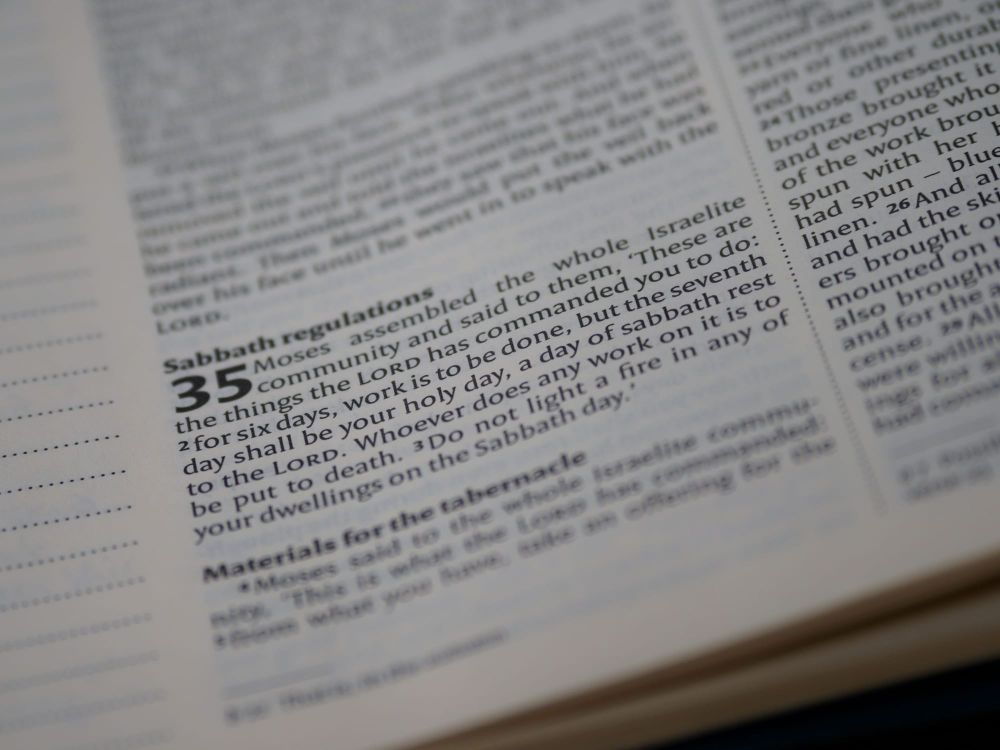
The Sabbath: A Liberty Made Into a Loyalty Test
The seventh-day Sabbath is not among the four counts, and the distinction matters. The day on which a Christian worships is a matter of conscience. What Adventism has built on top of that day is not.
The Day Itself
Fundamental Belief 20 holds that the seventh day is the Sabbath of creation and of the moral law, binding on all people in all ages: God instituted it before Israel existed (Genesis 2:1–3); He wrote it among the Ten Commandments (Exodus 20:8–11), which are moral and permanent as distinct from ceremonial laws fulfilled in Christ; Jesus kept it "as was His custom" (Luke 4:16) and called Himself "Lord even of the Sabbath" (Mark 2:28); He did not come to abolish the Law (Matthew 5:17–19); Paul reasoned in synagogues on the Sabbath (Acts 17:2; 18:4); "there remains therefore a Sabbath rest for the people of God" (Hebrews 4:9); and the new heavens and new earth include Sabbath worship (Isaiah 66:23).
Scripture addresses day-observance directly, and twice treats it as conscience:
Colossians 2:16–17 (NASB95): "Therefore no one is to act as your judge in regard to food or drink or in respect to a festival or a new moon or a Sabbath day — things which are a mere shadow of what is to come; but the substance belongs to Christ."
The word is σκιά (skia, Strong's G4639) — shadow, the shape cast by a body — and the body (σῶμα) casting it is Christ. Paul lists the standard Jewish calendar triad (annual festival, monthly new moon, weekly Sabbath), so the weekly Sabbath is explicitly included, and he forbids judging anyone over it. Likewise: "One person regards one day above another, another regards every day alike. Each person must be fully convinced in his own mind" (Romans 14:5–6), with mutual acceptance and no contempt in either direction (vv. 3, 10). And to those adopting the calendar as obligation: "You observe days and months and seasons and years. I fear for you" (Galatians 4:10–11).
Briefly on the supporting texts: the moral/ceremonial partition is a theological construct, not a biblical category — Scripture treats the Law as a unit (James 2:10; Galatians 5:3), and the Ten Commandments are themselves called the words of the covenant made at Horeb (Exodus 34:28; Deuteronomy 4:13; 5:2–3), with the Sabbath named a sign between God and Israel specifically (Exodus 31:16–17; Ezekiel 20:12) and grounded in the Exodus rather than creation in Deuteronomy's version (Deuteronomy 5:15). Genesis 2:1–3 records God's rest and blessing but contains no command to man, and no Sabbath observance appears in Genesis at all; the first command comes at Exodus 16, where it is presented as newly made known ("You made known to them Your holy sabbath," Nehemiah 9:14). Matthew 5:17 says Christ came to fulfill — πληρόω (plēroō, G4137) — which is exactly the Colossians 2 argument, not a rebuttal of it. Hebrews 4:9 uses σαββατισμός (sabbatismos, G4520) of a rest the context defines as ceasing from one's own works and entering God's rest by faith "today" (vv. 3, 7, 10), the writer's point being that Joshua did not give them that rest (v. 8) — an argument about faith-rest in Christ, not weekly observance. And the apostolic decision of Acts 15:28–29 is instructive by omission: the church named four requirements for Gentile believers and said nothing about the Sabbath, which is inexplicable if Sabbath-breaking were the covenant violation Adventist eschatology makes of it.
Where the day lands: Sabbath-keeping is permissible and can be genuinely edifying. Requiring it of all Christians is not.
The Seal and the Mark — An Addition With No Textual Warrant
This is where the Sabbath stops being a liberty question and becomes evidence for the case above.
Adventism assigns the Sabbath eschatological weight it does not carry in Scripture: in its historicist reading of Revelation 13–14, seventh-day observance becomes the seal of God and enforced Sunday worship the mark of the beast.
Read the passage. Revelation 13:16–17 locates the mark on the hand or forehead and ties it to commerce and to worship of the beast's image. The text says nothing whatsoever about a day of worship. The identification is supplied entirely from outside — from a historicist framework secured by a nineteenth-century prophetic voice — and then read back in.
Weigh what is at stake in that inference. Those who receive the mark "will drink of the wine of the wrath of God" and are "tormented with fire and brimstone" (Revelation 14:9–11). To attach that sentence to a question of which day a believer gathers for worship — on the strength of an inference the text does not make — is to bind consciences with a threat God has not issued. That is precisely what Deuteronomy 4:2 forbids and what Proverbs 30:6 warns will prove the one who does it a liar.
Contemporary Adventist statements have moderated the application — no one bears the mark today, Sunday-keeping Christians worship in good conscience, the issue becomes decisive only under future coercion. That moderation is worth noting for accuracy's sake. It does not repair the underlying problem. A doctrine that has to be softened in application because its plain form is intolerable is a doctrine that should be abandoned, not managed.
Lifestyle Distinctives
The Adventist health message — vegetarianism, abstinence from alcohol and tobacco, avoidance of unclean meats (Leviticus 11) — is a different category and should be treated as one. Paul is explicit that food is not a boundary marker: "Food will not commend us to God" (1 Corinthians 8:8); "the kingdom of God is not eating and drinking, but righteousness and peace and joy in the Holy Spirit" (Romans 14:17); Jesus "declared all foods clean" (Mark 7:19), and Peter's vision applies the point (Acts 10:15); prohibiting foods "which God has created to be gratefully shared" is named among the marks of deceitful teaching (1 Timothy 4:1–5). Equally, Romans 14:2–3 forbids the meat-eater to despise the abstainer.
In practice most Adventists present the health message as wisdom rather than as a condition of salvation, and the results are not nothing: Loma Linda is one of the world's identified longevity "Blue Zones," and the Adventist Health Studies have documented life-expectancy advantages of roughly seven to ten years. Christians who believe the body is the Spirit's temple (1 Corinthians 6:19–20) have no cause to disparage the practice. The objection is only to its origin in a health vision rather than in Scripture, and to any elevation of it into a requirement.
Conclusion
| Doctrine | Confessed on paper | What is added | Scripture |
|---|---|---|---|
| God | One God in three coeternal Persons | — | Agreed |
| Christ | Fully God, bodily raised, returning visibly | — | Agreed |
| Salvation | By grace through faith, not works | — | Agreed |
| Scripture | Inspired, authoritative, sufficient | A modern prophet who settles doctrine | Canon closed — Jude 3; Hebrews 1:1–2 |
| Christ's priestly work | Entered at the ascension | A second phase begun in 1844 | Entered once for all — Hebrews 9:12; 10:14 |
| The believer's standing | Saved by grace | A pre-advent review of the record | "No condemnation" — Romans 8:1; John 5:24 |
| The dead | — | Unconscious sleep; wicked annihilated | Conscious; punishment eternal — Luke 16:22–25; Matthew 25:46 |
| The church | — | Adventism as the end-time remnant | Remnant by grace — Romans 11:5; Matthew 16:18 |
| The Sabbath | Seventh day binding | Seal of God vs. mark of the beast | Matter of conscience — Colossians 2:16–17; Romans 14:5 |
Read the middle column. That is the finding of this study.
Seventh-day Adventism is not a Christian denomination with unusual distinctives. It is a nineteenth-century movement that stands outside historic biblical Christianity, because it has done the one thing Scripture forbids doing to Scripture: it has added. A prophet whose writings settle what the text leaves unsettled. A judgment the Bible never describes, invented to explain a date that failed. A doctrine of the dead the Bible contradicts. A remnant identity the Bible assigns to no organization. And a loyalty test attached to a day, carrying a threat of divine wrath the text does not attach to it.
The orthodox confession at the front of the 28 Fundamental Beliefs is real, and it is why Adventism should never be described in the same terms as Mormonism or the Watch Tower, which deny the deity of Christ outright. But an orthodox confession is not a license. Galatia's error was not a defective statement of faith; it was an addition to a sufficient gospel, and Paul treated the addition as decisive. The question Scripture asks is not how much did they get right but did they add to the word. Adventism did, and continues to.
Two things follow, and they belong together.
First, the door is not closed on individuals. Anyone who trusts Jesus Christ — God in the flesh, crucified for sinners, bodily risen — is saved by Him, and God knows those who are His in every place people gather (2 Timothy 2:19). This study assesses a system, and a system's verdict is not automatically the verdict on every person inside it. Many sincere Adventists love Christ and rest on His finished work.
Second, that is exactly why the system has to be named. The kindest thing anyone can do for a person carrying the weight of an investigative judgment is show them Hebrews 10:14 — perfected for all time — and Romans 8:1 — now no condemnation. The finished work of Christ needs no second phase, and no believer's standing is still under review. That is not a denominational argument. It is the plain word of God, and it is enough.
"To the law and to the testimony! If they do not speak according to this word, it is because they have no dawn." — Isaiah 8:20
Author

Raised in a Christian home, I came to faith later in life. A family crisis in 2019 drove me to study Scripture deeply, and by 2021 I answered my calling to ministry and teaching God's Word.