Three at Once - The Scenes Where the Whole Trinity Appears

"Go therefore and make disciples of all the nations, baptizing them in the name of the Father and the Son and the Holy Spirit."
— Matthew 28:19 (NASB95)
Most arguments for the Trinity are cumulative. You establish that the Father is God, then that the Son is God, then that the Spirit is God, then that the three are distinct, and the doctrine emerges from the sum.
There is a smaller and sharper category of evidence: passages where all three appear at once, named together, doing distinguishable things, in a single breath. These are the texts that cannot be explained by a God who merely changes masks, and they are the reason no early Christian had to be talked into Trinitarian language. It was already how they baptized, blessed, and greeted one another.
Four of them are examined here — a scene, a command, a blessing, and a greeting. They span the beginning of Jesus's ministry, the end of Matthew's Gospel, the close of a Pauline letter, and the opening of Revelation.
The Baptism — Three Persons, One Moment
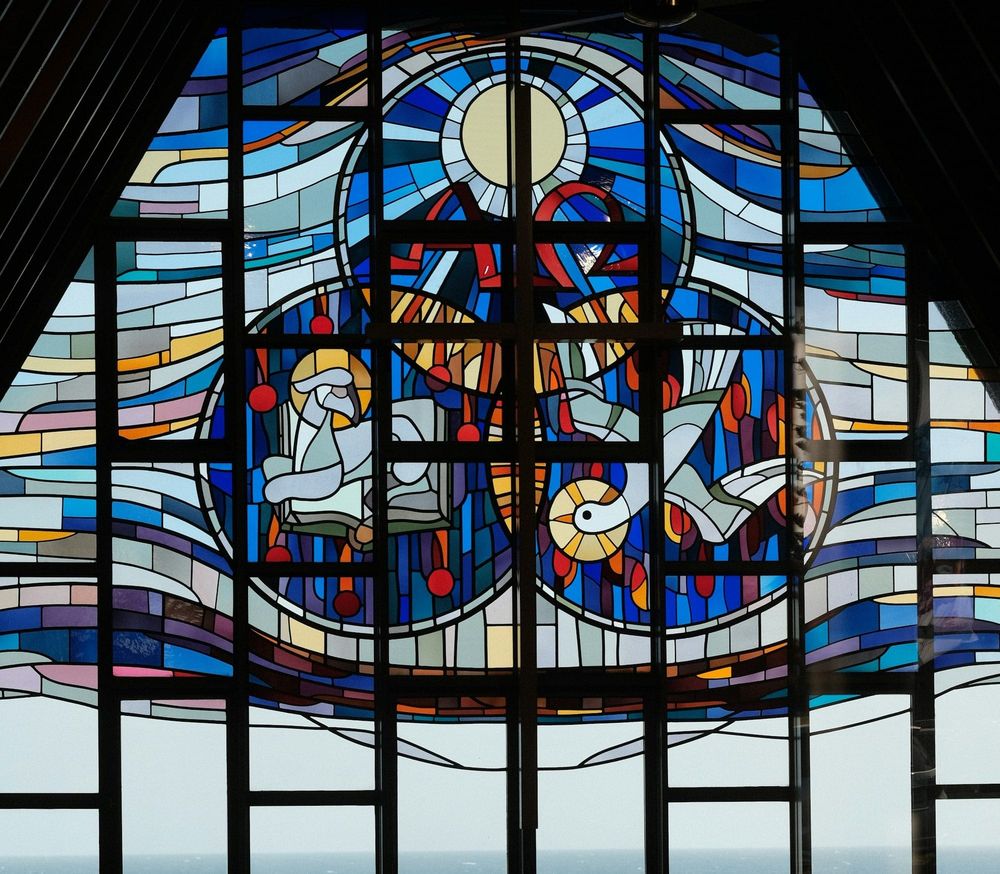
Matthew 3:16–17 (NASB95): "After being baptized, Jesus came up immediately from the water; and behold, the heavens were opened, and he saw the Spirit of God descending as a dove and settling on Him; and behold, a voice out of the heavens said, 'This is My beloved Son, in whom I am well-pleased.'"
Read the geography of the scene, because the geography is the argument.
The Son is in the Jordan, standing in the water. The Spirit descends from above and settles on Him. The Father speaks from heaven about Him. Three locations, three actions, three grammatical subjects — simultaneously.
This is the passage that ends modalism, and it ends it without needing a single technical term. Modalism holds that Father, Son, and Spirit are one person appearing successively in three modes — God wearing three masks, one at a time. But here there is no succession. The Son cannot be the Father speaking about Himself in the third person from a location He is not occupying, while also descending on Himself as a dove.
Two details reward attention.
The Spirit descending. The verb is καταβαίνω (katabainō, "to come down, descend") — movement from the heavenly realm onto the Son who stands on earth. The image of the Spirit over the water deliberately recalls Genesis 1:2, where the Spirit of God hovers over the waters at creation. The same Spirit who presided over the first creation now presides over the inauguration of the new.
The Father's words. "This is My beloved Son, in whom I am well-pleased" fuses two Old Testament texts: "You are My Son" (Psalm 2:7), the enthronement of the messianic King, and "My chosen one in whom My soul delights" (Isaiah 42:1), the commissioning of the Servant of the LORD. In one sentence the Father identifies Jesus as both the reigning King and the suffering Servant.
Athanasius, in his letters to Serapion defending the deity of the Spirit against those who would make Him a creature, argued from precisely this indivisibility: the Triad is not a hierarchy of unequal beings but one God, and what is done by the Father is done through the Son in the Spirit. The Jordan is where that becomes visible rather than merely argued.
The Great Commission — One Name, Three Persons
Matthew 28:18–20 (NASB95): "All authority has been given to Me in heaven and on earth. Go therefore and make disciples of all the nations, baptizing them in the name of the Father and the Son and the Holy Spirit…"
The Greek is εἰς τὸ ὄνομα τοῦ πατρὸς καὶ τοῦ υἱοῦ καὶ τοῦ ἁγίου πνεύματος, and the load-bearing word is one most readers pass over.
ὄνομα is singular. Not names. One name — belonging jointly to Father, Son, and Holy Spirit.
That is not a stylistic preference. Had Matthew written names, the formula would list three parties who happen to be mentioned together, the way one might name three signatories. The singular says the three share one name, which in Hebrew and Greek usage means one identity, one authority, one divine reality.
The construction reinforces it. The three are joined by καί in strict grammatical parallel, each with its own definite article — the Father, the Son, the Holy Spirit — a form that marks them as distinct while binding them under the single name. And note what never appears anywhere in Scripture: a parallel formula coordinating God with angels, or God with prophets, or God with Moses. The three-fold name has no competitors.
On the textual objection. It is sometimes claimed that the triune formula is a later insertion, on the grounds that Eusebius occasionally quotes the verse in a shorter form ("in my name"). The claim does not survive the evidence: every extant Greek manuscript of Matthew contains the three-fold formula, without exception, and the same formula is attested in the Didache (7:1) and in Justin Martyr before Eusebius was born. A patristic paraphrase does not outweigh the entire manuscript tradition.
What can fairly be said is that Matthew gives a baptismal formula, not a developed doctrine of the Trinity — the theological vocabulary of substance and person came centuries later. But the formula is what the vocabulary was eventually built to explain, and it was in use from the beginning. That history is traced in whether Nicaea invented the Trinity.
The Benediction — Three Persons, Three Gifts
2 Corinthians 13:14 (NASB95): "The grace of the Lord Jesus Christ, and the love of God, and the fellowship of the Holy Spirit, be with you all."
Paul ends a long, bruising letter with a blessing, and the blessing is triadic.
| Person | Gift |
|---|---|
| The Lord Jesus Christ | grace — charis |
| God (the Father) | love — agapē |
| The Holy Spirit | fellowship — koinōnia |
Two things make this more than a rhetorical flourish.
First, Paul is not arguing here. He is signing off. Which means the triadic structure is not a position he is defending against opponents — it is the shape his instincts already had. Doctrine that shows up in a benediction is doctrine that has stopped being controversial.
Second, κοινωνία ("fellowship, sharing, participation") is not a lesser category than grace and love. The Spirit is credited with creating and sustaining the believer's participation in God and in one another. Whatever Paul thought the Spirit was, he did not think of Him as an influence one has; he thought of Him as a person one shares with.
Note also the order — Son, Father, Spirit. Paul is not working from a fixed hierarchy. He begins with Christ because Christ is where grace meets the Corinthians, and he feels no pressure to rank the three.
The benediction is addressed "to you all" — the whole fractious congregation, including the people who had been attacking him. Trinitarian grace is not a reward for the mature.
The Greeting — Grace from Three Sources
Revelation 1:4–5 (NASB95): "Grace to you and peace, from Him who is and who was and who is to come, and from the seven Spirits who are before His throne, and from Jesus Christ, the faithful witness, the firstborn of the dead, and the ruler of the kings of the earth."
John opens the last book of Scripture the way Matthew closed the first Gospel.
"Him who is and who was and who is to come" — the Father, and the phrase is a deliberate expansion of the divine name of Exodus 3:14, I AM, stretched across past, present, and future.
There is a famous grammatical oddity here worth getting right, because it is often garbled. The preposition ἀπό ("from") requires the genitive case. John instead writes ὁ ὢν — the nominative. He commits a deliberate solecism, refusing to decline the divine name, treating it as an indeclinable proper noun. The name will not be bent to fit a preposition.
"The seven Spirits who are before His throne" — most read this as the Holy Spirit in sevenfold fullness, seven being the number of completeness, echoing the sevenfold Spirit of Isaiah 11:2 and the seven lamps of Zechariah 4:1–10.
"Jesus Christ" — the Son, with three titles: faithful witness, firstborn of the dead, ruler of the kings of the earth.
Grace and peace are said to come from all three. In a book that will spend twenty-two chapters insisting that worship belongs to God alone — twice stopping John from bowing to an angel (Revelation 19:10; 22:8–9) — the source of divine blessing is named as three.
And the Spirit is placed between the Father and the Son rather than trailing behind both. Whatever John was doing, he was not arranging a hierarchy of descending importance.
What the Four Have in Common
None of these texts is arguing for the Trinity. That is the point worth ending on.
Matthew is narrating a baptism. Jesus is issuing a commission. Paul is closing a letter. John is greeting seven churches. In each case, the three-fold pattern appears in material where nothing is being defended — in liturgy, in blessing, in narrative, in correspondence. It is not the conclusion of an argument. It is the water the writers were already swimming in.
Doctrines that have to be argued for leave a trail of argument behind them. This one shows up first in the way the earliest Christians baptized people and said goodbye. The theological vocabulary took three centuries to settle. The practice did not need to wait.
For the argument that the same structure runs through salvation itself, see how the Trinity saves you; for the objections most often raised against all of this, see common objections to the Trinity, answered.
Author

Raised in a Christian home, I came to faith later in life. A family crisis in 2019 drove me to study Scripture deeply, and by 2021 I answered my calling to ministry and teaching God's Word.