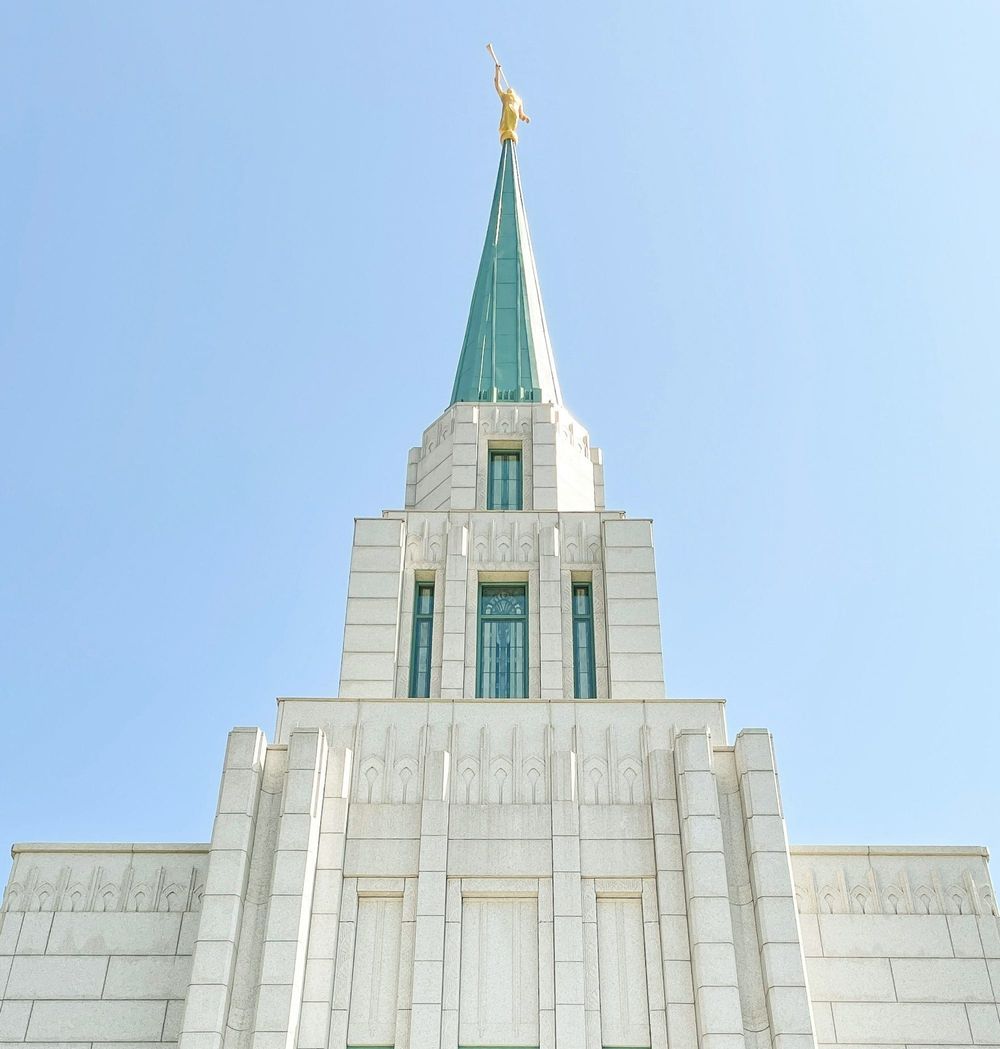
Christianity vs Mormonism
The decisive issue is the **identity of God**, because every other doctrine follows from it. If God has always been the only God — never formed, never a man, never one of many — then the Mormon account of eternal progression cannot be true

The Church of Jesus Christ of Latter-day Saints uses the vocabulary of historic Christianity almost without exception. It speaks of God the Father, of Jesus Christ as Savior and Son of God, of the Holy Ghost, of the atonement, of grace, faith, repentance, baptism, and resurrection. It bears Christ's name in its title and centers its worship on Him. This shared vocabulary is entirely sincere, and it accounts for the widespread impression that Mormonism is simply another Christian denomination — perhaps unusual in its history and practices, but fundamentally a variety of Christian faith.
A careful comparison shows something different. The words are shared; the definitions beneath them are not. When Mormonism says "God," it means an exalted, embodied Man who was once mortal and progressed to deity, one of a plurality of gods. When historic Christianity says "God," it means the one eternal, immaterial, unchanging Being who alone has always been God and beside whom no other god exists or ever will. When Mormonism says "Jesus Christ," it means the Father's firstborn spirit child, the elder brother of all human spirits (and of Lucifer), who attained divinity. When Christianity says "Jesus Christ," it means the eternal Word who was God, through whom all things were made, who took on flesh without ceasing to be God. When Mormonism says "grace," it means divine help that becomes effectual "after all we can do," through ordinances performed by proper priesthood authority. When the New Testament says "grace," it means unearned favor that justifies the ungodly apart from works.
Because these differences lie at the level of definition, they cannot be resolved by goodwill or by noting the many admirable qualities of Latter-day Saints — their family devotion, moral seriousness, sobriety, industry, and generosity are real and worthy of respect. Nothing in this study is written to mock Mormonism or to demean Latter-day Saints, who are made in God's image (Genesis 1:27) and are to be treated with the courtesy owed to every neighbor. The study is written to lay both systems side by side from their own primary sources — the NASB95 Bible on the Christian side; the Book of Mormon, Doctrine and Covenants, Pearl of Great Price, Articles of Faith, and official LDS publications on the Mormon side — so that the actual points of contradiction are visible rather than obscured by shared terminology.
Each section below states what Mormonism teaches, in its own words and with its own proof texts, before setting the biblical text alongside it. The doctrines examined are: the nature of God; the person of Jesus Christ; the Holy Spirit; Scripture and authority; salvation, grace, and works; humanity, the Fall, and human destiny; the church and priesthood; and the afterlife.
The Nature of God — One Eternal God vs. an Exalted Man Among Many Gods
What Mormonism Teaches
Mormonism rejects the Trinity as historically defined and replaces it with a Godhead of three separate beings united in purpose. Doctrine and Covenants 130:22 states that "The Father has a body of flesh and bones as tangible as man's; the Son also; but the Holy Ghost has not a body of flesh and bones, but is a personage of Spirit." God the Father is thus a physical, embodied being located in space.
Further, God the Father is understood to have been a mortal man who progressed to godhood. In the King Follett discourse (April 7, 1844), Joseph Smith taught: "God himself was once as we are now, and is an exalted man." The text is published by the church itself (see "King Follett Discourse"). President Lorenzo Snow's couplet summarized it: "As man now is, God once was: as God now is, man may be."
Correspondingly, Mormonism affirms a plurality of gods. The Book of Abraham renders the creation account with "the Gods" acting in council (Abraham 4:1ff.), and D&C 132:20 promises the faithful that "then shall they be gods, because they have all power." The church's essay "Becoming Like God" affirms this divine potential.
LDS proof-texts for a plurality include Genesis 1:26 ("Let Us make man in Our image"), Psalm 82:6 ("You are gods"), John 10:34, 1 Corinthians 8:5 ("there are many gods and many lords"), and John 17:21–22 (the oneness of Father and Son understood as unity of purpose, extended to believers).
What Christianity Teaches
Scripture's monotheism is not merely numerical but exclusive and eternal. God declares through Isaiah that no god existed before Him and none will exist after — a statement that directly forecloses both a Father who was once a man and faithful humans who become gods:
Isaiah 43:10 (NASB95): "'You are My witnesses,' declares the LORD, 'And My servant whom I have chosen, So that you may know and believe Me And understand that I am He. Before Me there was no God formed, And there will be none after Me.'"
The Hebrew is emphatic: no god was formed (יָצַר, yātsar, Strong's H3335 — to form, fashion, as a potter shapes clay; HALOT, s.v.) before Him, and none shall be after. If God the Father was once a man who became God, then a God was formed before the present one; if faithful Latter-day Saints become gods, then gods will exist after Him. Isaiah forbids both. The same denial recurs with unusual frequency: "I am the first and I am the last, And there is no God besides Me" (Isaiah 44:6); "Is there any God besides Me? Or is there any other Rock? I know of none" (Isaiah 44:8) — where God does not merely deny other gods' legitimacy but denies knowing of any; "I am the LORD, and there is no other; Besides Me there is no God" (Isaiah 45:5; cf. 45:21–22; 46:9).
God is also unchanging and therefore cannot have progressed from manhood to deity: "For I, the LORD, do not change" (Malachi 3:6); "from everlasting to everlasting, You are God" (Psalm 90:2) — He is God across the whole span in both directions, not God at one end of a progression. And He is explicitly not a man: "God is not a man, that He should lie, Nor a son of man, that He should repent" (Numbers 23:19); "For I am God and not man, the Holy One in your midst" (Hosea 11:9).
As to God's being: "God is spirit, and those who worship Him must worship in spirit and truth" (John 4:24) — πνεῦμα (pneuma, Strong's G4151), which by Christ's own definition excludes flesh and bones: "a spirit does not have flesh and bones as you see that I have" (Luke 24:39). God is not confined to a location but fills heaven and earth (1 Kings 8:27; Jeremiah 23:24), which an embodied being cannot do.
On the LDS proof-texts. Psalm 82:6 ("You are gods") is a sentence passed in a courtroom, not a promise held out to anyone. Who the ʾĕlōhîm of that psalm are is debated — corrupt human rulers on the older reading, members of God's heavenly council on the reading the Hebrew of v. 1 more naturally supports — but on either reading God condemns them and sentences them to mortality: "Nevertheless you will die like men and fall like any one of the princes" (v. 7). Beings who can be sentenced to die are creatures, which is the reverse of what the LDS reading needs the verse to establish; Jesus cites it in John 10:34–36 precisely as an a fortiori argument for His own unique sonship. 1 Corinthians 8:5 is completed by v. 6: though there are "so-called gods," "yet for us there is but one God, the Father... and one Lord, Jesus Christ" — Paul is describing pagan idols, and v. 4 says flatly "there is no God but one." Genesis 1:26's plural "Us" is an address to God's heavenly court — the same assembly seen in 1 Kings 22:19, Psalm 82:1, Isaiah 6:8 and Daniel 4:17 — and v. 27 reverts at once to the singular: "God created man in His own image." God consults; God alone creates. The verse yields no second god and no council of equals. And the oneness of John 17:21–22 is a unity believers are invited into, which no Mormon claims makes believers ontologically God the Father; the passage cannot bear the weight of redefining divine unity as mere agreement, since John 10:30 provoked a charge of blasphemy for making Himself God (v. 33).
Historic Christianity confesses one God eternally existing in three co-equal, co-eternal Persons — Father, Son, and Holy Spirit — one in essence, distinct in Person: the Triune name into which disciples are baptized (Matthew 28:19, one name, three Persons), and the apostolic benediction (2 Corinthians 13:14).
The Person of Jesus Christ — Eternal God vs. Firstborn Spirit Child
What Mormonism Teaches
Latter-day Saints affirm Jesus as Savior, Redeemer, and Son of God, and their devotion to Him is genuine. But in LDS theology, He is the firstborn spirit child of Heavenly Father, the first of the Father's spirit offspring, who progressed to divinity and became Jehovah of the Old Testament (while the Father is Elohim). All human beings are likewise spirit children of the Father, making Christ our elder brother — and, since Lucifer is also a spirit son of God who rebelled in the pre-mortal council, Jesus and Satan are in that sense spirit brothers (Moses 4:1–4; Abraham 3:22–28).
The atonement is understood to have been accomplished significantly in Gethsemane as well as at the cross, and it secures universal resurrection unconditionally while making exaltation available conditionally.
What Christianity Teaches
The New Testament places Christ on the Creator's side of the Creator/creature line, without remainder:
John 1:1–3 (NASB95): "In the beginning was the Word, and the Word was with God, and the Word was God. He was in the beginning with God. All things came into being through Him, and apart from Him nothing came into being that has come into being."
Three clauses matter. "In the beginning was" — the imperfect ἦν (ēn) denotes continuous existence already when the beginning began; John deliberately avoids ἐγένετο (egeneto, "came into being"), which he uses of created things in v. 3 and of the incarnation in v. 14. "The Word was with God" — distinction of Person. "The Word was God" — θεὸς ἦν ὁ λόγος, where the anarthrous predicate nominative preceding the verb is qualitative, asserting that the Word possesses the very nature of God (see the discussion of Colwell's and Harner's analysis). And v. 3 forecloses any created status: nothing that has come into being came into being apart from Him — so He Himself did not come into being.
Paul says the same in creation terms: "For by Him all things were created, both in the heavens and on earth, visible and invisible... all things have been created through Him and for Him. He is before all things, and in Him all things hold together" (Colossians 1:16–17) — and adds that "in Him all the fullness of Deity dwells in bodily form" (Colossians 2:9), θεότης (theotēs, Strong's G2320) denoting deity in the absolute sense, the state of being God. Hebrews calls Him "the radiance of His glory and the exact representation of His nature" (Hebrews 1:3) and has the Father address Him directly as God: "Your throne, O God, is forever and ever" (Hebrews 1:8). Thomas confesses Him as "My Lord and my God!" and is blessed rather than corrected (John 20:28–29). Jesus claims the divine name outright: "before Abraham was born, I am" (John 8:58; cf. Exodus 3:14), at which His hearers took up stones.
If Christ created all things, He cannot be among the things created — which is the decisive difference from the LDS account of a firstborn spirit child who progressed to deity. He is not the first product of God's creative work but its Author; not one who became divine but the one who was God and became flesh (John 1:14; Philippians 2:6–7).
On the "elder brother" framing: Scripture does call Christ "the firstborn among many brethren" (Romans 8:29), but the sonship of believers is by adoption (υἱοθεσία, huiothesia, Strong's G5206 — the legal conferral of sonship on those not sons by nature; Romans 8:15; Galatians 4:5; Ephesians 1:5), while His is by nature — He is the μονογενής (monogenēs, G3439), the unique, one-of-a-kind Son (John 1:18; 3:16). Believers become children of God by receiving Him (John 1:12); we were not His siblings already. And Scripture never presents Satan as a son of God in the sense of a brother of Christ; he is a created being under judgment, and Christ is his Creator (Colossians 1:16; 1 John 3:8).
On the atonement's location: Scripture consistently locates the sin-bearing at the cross — "He Himself bore our sins in His body on the cross" (1 Peter 2:24); "having cancelled out the certificate of debt... He has taken it out of the way, having nailed it to the cross" (Colossians 2:14); "It is finished" spoken there (John 19:30). Gethsemane is Christ's anguished submission to the cup, not the drinking of it (Matthew 26:39).
The Holy Spirit and the Godhead's Unity
What Mormonism Teaches
The Holy Ghost is the third member of the Godhead — a personage of spirit without a body of flesh and bones (D&C 130:22), distinct in being from the Father and the Son, united with them in purpose. LDS teaching also distinguishes the "Light of Christ," a diffuse divine influence, from the "gift of the Holy Ghost," conferred by the laying on of hands after baptism, by one holding priesthood authority.
What Christianity Teaches
Scripture presents the Spirit as a divine Person who shares the one divine essence with the Father and the Son — not a third, separate god. He is called God directly: lying to the Holy Spirit is restated in the same breath as lying to God (Acts 5:3–4). He possesses incommunicable divine attributes — eternity (Hebrews 9:14), omniscience searching "the depths of God" (1 Corinthians 2:10–11), omnipresence (Psalm 139:7–10) — performs divine works (creation, Genesis 1:2; regeneration, John 3:5–8; resurrection, Romans 8:11), and speaks the Old Testament's YHWH-speech in the first person (Acts 28:25–27; Hebrews 3:7–11).
The crucial difference is not whether the Spirit is personal — both traditions affirm that — but whether the three are one Being or three beings. Scripture's monotheism (above) requires the former: one God, three Persons, one indivisible essence.
Scripture and Authority — A Closed Canon vs. an Open One
What Mormonism Teaches
Article of Faith 8: "We believe the Bible to be the word of God as far as it is translated correctly; we also believe the Book of Mormon to be the word of God." The qualifier reflects the teaching that "many plain and precious things" were removed from the biblical record (1 Nephi 13:26–29). Alongside the Bible stand the Book of Mormon, Doctrine and Covenants, and Pearl of Great Price, and above all stands continuing revelation through a living prophet (Article of Faith 9).
LDS proof-texts include Ezekiel 37:15–20 (the two sticks of Judah and Joseph, read as Bible and Book of Mormon), John 10:16 ("other sheep I have"), and Amos 3:7 (God reveals through prophets).
What Christianity Teaches
Scripture presents itself as sufficient and complete for faith and practice: "All Scripture is inspired by God and profitable for teaching... so that the man of God may be adequate, equipped for every good work" (2 Timothy 3:16–17) — ἄρτιος (artios, Strong's G739, "complete, capable"), leaving no deficiency requiring supplementary scripture. The faith was "once for all handed down to the saints" (Jude 3) — ἅπαξ (hapax, G530), once for all, not progressively re-delivered.
The apostolic foundation is laid once (Ephesians 2:20), and God's final word is spoken in the Son: "God, after He spoke long ago to the fathers in the prophets in many portions and in many ways, in these last days has spoken to us in His Son" (Hebrews 1:1–2). Scripture repeatedly fences itself against addition and subtraction (Deuteronomy 4:2; Proverbs 30:5–6; Revelation 22:18–19).
Most pointedly, Paul anticipates precisely the scenario of a new gospel delivered by an angelic messenger: "But even if we, or an angel from heaven, should preach to you a gospel contrary to what we have preached to you, he is to be accursed!" (Galatians 1:8). This does not by itself settle whether Moroni's message was contrary — that is determined by comparing its doctrine with the apostolic gospel, which is the work of this entire study — but it establishes that angelic credentials cannot override doctrinal content.
On the "great apostasy." The claim that the true church vanished entirely runs against Christ's promise that "the gates of Hades will not overpower it" (Matthew 16:18) and His pledge to be with His people "always, even to the end of the age" (Matthew 28:20), as well as the promise of a kingdom that "will never be destroyed" (Daniel 2:44) and glory to God "in the church... to all generations forever and ever" (Ephesians 3:21). Scripture predicts apostasies within the visible church (Acts 20:29–30; 1 Timothy 4:1) — never its total extinction.
On Ezekiel 37. The passage interprets itself: the two sticks are the divided kingdoms of Israel and Judah, and God's stated meaning is national reunification — "I will make them one nation in the land" (Ezekiel 37:22) — with one king over them. Nothing in the context concerns books.
On the transmission of the text. The premise that the Bible was substantially corrupted is testable, and the manuscript evidence runs the other way. The Dead Sea Scrolls (copied c. 250 BC–AD 68), discovered in 1947, place a complete Isaiah scroll roughly a millennium earlier than the previously oldest Hebrew manuscripts and show remarkable stability of the text (see the digitized Great Isaiah Scroll). The New Testament survives in thousands of Greek manuscripts, some within a century or so of composition — a transmission record far richer than any other ancient work — and no textual variant places a doctrine in doubt.
Salvation — Grace Through Faith vs. Grace After All We Can Do
What Mormonism Teaches
Mormonism distinguishes salvation (universal resurrection, granted to nearly all through Christ's atonement) from exaltation (eternal life in the highest degree of the celestial kingdom, in eternal family units, with progression toward godhood). Exaltation requires faith in Christ, repentance, baptism by immersion by one holding proper priesthood authority, receiving the Holy Ghost by laying on of hands, temple ordinances including eternal marriage, and enduring faithfully in obedience — with worthiness assessed in temple-recommend interviews covering tithing, the Word of Wisdom, chastity, and sustaining church leaders.
The signature text is 2 Nephi 25:23: "for we know that it is by grace that we are saved, after all we can do." Article of Faith 3 states that "all mankind may be saved, by obedience to the laws and ordinances of the Gospel." LDS proof-texts include James 2:24 ("justified by works"), Philippians 2:12 ("work out your salvation"), Matthew 7:21, and John 3:5 (born of water and Spirit, read as baptism's necessity).
What Christianity Teaches
The New Testament grounds justification in grace received by faith, explicitly excluding works as the basis, precisely so that boasting is eliminated:
Ephesians 2:8–9 (NASB95): "For by grace you have been saved through faith; and that not of yourselves, it is the gift of God; not as a result of works, so that no one may boast."
Paul's ledger-logic makes any "grace after works" formulation self-defeating: "Now to the one who works, his wage is not credited as a favor, but as what is due. But to the one who does not work, but believes in Him who justifies the ungodly, his faith is credited as righteousness" (Romans 4:4–5). And: "But if it is by grace, it is no longer on the basis of works, otherwise grace is no longer grace" (Romans 11:6). "He saved us, not on the basis of deeds which we have done in righteousness, but according to His mercy" (Titus 3:5); "a man is justified by faith apart from works of the Law" (Romans 3:28; cf. Galatians 2:16, which says it three times in one verse).
The difference is not whether works matter — both traditions insist they do — but where they sit. Scripture places them downstream as the fruit and evidence of salvation, never upstream as its ground: "For we are His workmanship, created in Christ Jesus for good works" (Ephesians 2:10) — saved not by works but for them. James is addressing the opposite error (dead, workless profession) and uses justified in its demonstrative sense — shown righteous, vindicated — as the Abraham chronology proves: Abraham was credited righteous in Genesis 15:6, decades before the offering of Isaac in Genesis 22 that James cites as the demonstration (James 2:21–23).
Scripture also offers present assurance, which a system of continuing worthiness assessment cannot: "These things I have written to you who believe in the name of the Son of God, so that you may know that you have eternal life" (1 John 5:13); "he who hears My word, and believes Him who sent Me, has eternal life, and does not come into judgment, but has passed out of death into life" (John 5:24) — present tense, already possessed.
On John 3:5. "Born of water and the Spirit" is best read against Ezekiel's promise of cleansing water and a new spirit (Ezekiel 36:25–27), which Nicodemus as "the teacher of Israel" should have known (v. 10) — new birth, not a sacramental prerequisite; the thief was received without baptism (Luke 23:43), and Cornelius received the Spirit before it (Acts 10:44–48).
On baptism for the dead. 1 Corinthians 15:29 is a single, notoriously obscure verse in which Paul refers to a practice in the third person ("they") without commending it, inside an argument whose entire point is the certainty of resurrection. Building a temple system on it collides with the New Testament's teaching that destiny is fixed at death: "it is appointed for men to die once and after this comes judgment" (Hebrews 9:27), and Jesus' account of a chasm that cannot be crossed after death (Luke 16:26).
Humanity, the Fall, and Human Destiny
What Mormonism Teaches
Human beings pre-existed as spirit children of Heavenly Father before mortal birth (Abraham 3:22–23), so mortality is a stage in an eternal progression rather than the beginning of existence. Article of Faith 2 denies inherited guilt: "men will be punished for their own sins, and not for Adam's transgression." The Fall is viewed positively as a necessary step: "Adam fell that men might be; and men are, that they might have joy" (2 Nephi 2:25). Children are innocent until the age of accountability (eight). The ultimate destiny of the exalted is godhood — becoming gods, with worlds and increase of their own (D&C 132:19–20).
What Christianity Teaches
Scripture presents human beings as created, not pre-existent: God "forms the spirit of man within him" (Zechariah 12:1); the first man became a living being when God breathed into formed dust (Genesis 2:7); and Paul's argument in Romans 9:11 depends on Jacob and Esau having "not yet been born and had not done anything good or bad" — impossible if they had a prior probationary existence.
The Fall is presented as a catastrophe, not an advantageous step: "through one man sin entered into the world, and death through sin, and so death spread to all men" (Romans 5:12); creation itself was "subjected to futility" (Romans 8:20–22). Humanity inherits a corrupted nature — "in sin my mother conceived me" (Psalm 51:5); "by nature children of wrath" (Ephesians 2:3) — which is why new birth, not merely instruction and ordinance, is required (John 3:3).
And the redeemed destiny is glorification into Christ's likeness, never deification into gods: "predestined to become conformed to the image of His Son" (Romans 8:29); "we will be like Him, because we will see Him just as He is" (1 John 3:2) — likeness, not identity of nature. The creature/Creator distinction is permanent; the redeemed forever worship God rather than joining His rank (Revelation 22:3–4). Indeed, the promise "you will be like God" is the serpent's original lie (Genesis 3:5), and the desire to ascend to deity is the archetypal fall (Isaiah 14:13–14; Ezekiel 28:2).
The Church, Priesthood, and Ordinances
What Mormonism Teaches
Valid ordinances require the restored Aaronic and Melchizedek priesthoods, conferred by laying on of hands in an unbroken chain from heavenly messengers to Joseph Smith. Baptisms and other ordinances performed outside this authority are invalid, which is why converts from other churches are rebaptized. Temples are essential for the highest ordinances, and only recommend-holding members may enter.
What Christianity Teaches
The New Testament knows a priesthood of all believers, not a restored sacerdotal order: "you are a chosen race, a royal priesthood, a holy nation, a people for God's own possession" (1 Peter 2:9; cf. 2:5; Revelation 1:6). The Melchizedek priesthood is held by Christ alone and is by definition untransferable: "He, on the other hand, because He continues forever, holds His priesthood permanently" — ἀπαράβατον (aparabaton, Strong's G531, "permanent, unchangeable, non-transferable"; BDAG, s.v.) — "therefore He is able also to save forever those who draw near to God through Him" (Hebrews 7:24–25; cf. Hebrews 7:11–17).
The temple has likewise been fulfilled: Christ's body is the true temple (John 2:19–21), the church is now God's temple (1 Corinthians 3:16; Ephesians 2:21–22), and the veil was torn so that every believer enters the holy place with boldness (Matthew 27:51; Hebrews 10:19–22). A system of secret ordinances restricted to the worthy sits uneasily with a gospel Jesus said He spoke openly, "nothing in secret" (John 18:20).
The Afterlife — Three Kingdoms vs. Two Destinies
What Mormonism Teaches
After death, spirits enter paradise or spirit prison, where the gospel continues to be preached, and proxy ordinances may be accepted. Following resurrection and judgment, nearly all humanity inherits one of three degrees of glory — celestial, terrestrial, or telestial (D&C 76) — with only the "sons of perdition" consigned to outer darkness. Families sealed in temples may continue eternally.
What Christianity Teaches
Scripture presents two final destinies, not a graded near-universalism. Jesus divides all nations into two groups with two outcomes: "These will go away into eternal punishment, but the righteous into eternal life" (Matthew 25:46) — the same adjective αἰώνιος (aiōnios, Strong's G166) governing both. The judgment turns on whether one's name is in the book of life (Revelation 20:15), and the road is narrow or broad with no third path (Matthew 7:13–14). Paul's "third heaven" (2 Corinthians 12:2) reflects a common Jewish way of speaking of God's dwelling above sky and space, not three kingdoms of glory; and the differing "glory" of sun, moon, and stars in 1 Corinthians 15:41 illustrates resurrection-body variety, not tiered salvation — the chapter's contrast is simply perishable versus imperishable.
On eternal marriage: Jesus states directly that "in the resurrection they neither marry nor are given in marriage, but are like angels in heaven" (Matthew 22:30), and Paul says marriage binds "as long as he lives" (Romans 7:2; 1 Corinthians 7:39). The Christian hope for reunion is real, but it is grounded in resurrection and the presence of Christ, not in the perpetuation of marital sealing.
Conclusion
The comparison yields a consistent pattern. On every doctrine that defines a religion, Mormonism and historic Christianity use the same words with incompatible meanings:
| Doctrine | Mormonism | Historic Christianity |
|---|---|---|
| God | Exalted, embodied Man; one of many gods; three separate beings | One eternal, immaterial, unchanging God in three Persons |
| Jesus Christ | Firstborn spirit child who became divine; our elder brother | Eternal Word, Creator of all things, God incarnate |
| Holy Spirit | A separate personage of spirit | The third Person of the one Godhead |
| Scripture | Bible "as far as translated correctly," plus three books and living prophets | A closed, sufficient canon; faith once for all delivered |
| Salvation | Grace "after all we can do"; ordinances and worthiness required for exaltation | Grace through faith apart from works; works as fruit |
| Humanity | Pre-existent spirits; no inherited guilt; may become gods | Created beings; fallen in Adam; glorified into Christ's likeness |
| Church | Restored priesthood after total apostasy | Christ's indestructible church; priesthood of all believers |
| Afterlife | Three degrees of glory; eternal families | Two destinies; resurrection to eternal life or judgment |
The decisive issue is the identity of God, because every other doctrine follows from it. If God has always been the only God — never formed, never a man, never one of many (Isaiah 43:10; 44:6, 8; Malachi 3:6) — then the Mormon account of eternal progression cannot be true, and the gospel of exaltation built upon it cannot stand. Conversely, if Joseph Smith's account is true, then Isaiah's God did not know what He was talking about. Both cannot be right.
This is not a reason for contempt toward Latter-day Saints, whose sincerity and moral seriousness are frequently exemplary, and who in many cases have never heard these texts set out plainly. It is a reason for clarity and for honest conversation — conducted, as Peter directs, "with gentleness and reverence" (1 Peter 3:15) — because what is at stake is the identity of the God who saves and the sufficiency of the Christ who saves. The good news that Scripture presses is precisely that the standard Mormonism sets ("after all we can do") is not the standard God sets: "to the one who does not work, but believes in Him who justifies the ungodly, his faith is credited as righteousness" (Romans 4:5).
Author

Raised in a Christian home, I came to faith later in life. A family crisis in 2019 drove me to study Scripture deeply, and by 2021 I answered my calling to ministry and teaching God's Word.