Christianity vs Hebrew Israelites
Hebrew Israelism's emotional center is Deuteronomy 28 — an identity forged in the recognition of one's own suffering in the text. That recognition is not foolish, and the suffering was real.
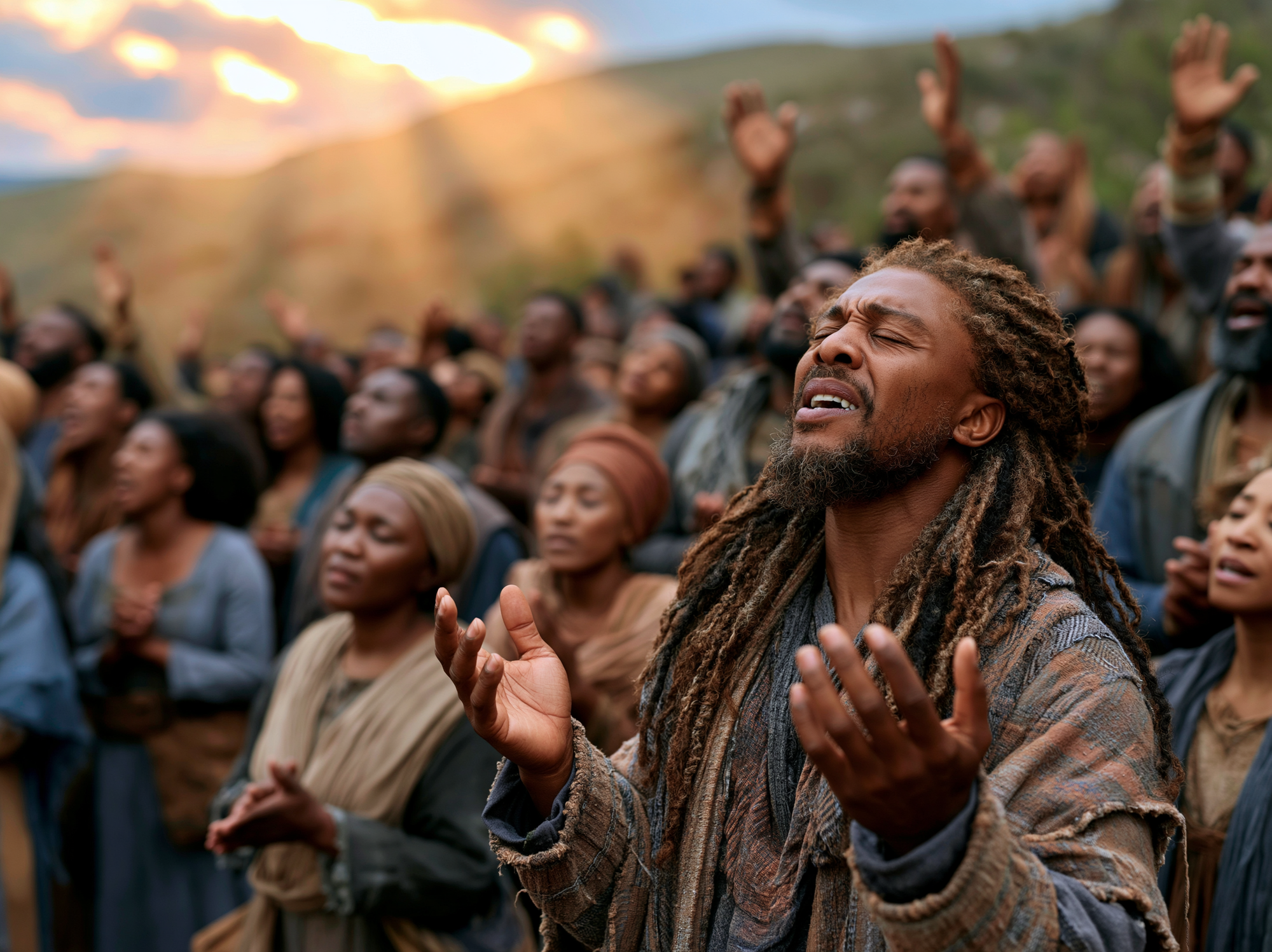
Hebrew Israelism presents Christians with an unusual apologetic situation. Its argument is made entirely from the Bible, often from passages that churches genuinely neglect: the genealogies, the covenant curses of Deuteronomy 28, the ceremonial law, the physical descriptions in Lamentations and Song of Solomon. Its adherents are frequently better acquainted with those texts than their Christian interlocutors, and they know it.
The movement is also not monolithic, and the failure to say so has wrecked a great many well-meant responses. Between the Church of God and Saints of Christ, which has confessed Jesus Christ since 1896, and the One West camps, which teach that whites are cursed Edomites to be destroyed or enslaved at the Messiah's return, there is more distance than between many Protestant denominations. This study therefore distinguishes throughout: some disagreements below are with the movement generally; others are only with the camps.
Something else must be said before the disagreements, because it is true and because Christians who skip it are not heard. The historical grievance driving Hebrew Israelism is not imaginary. Enslaved Africans were stripped of language, lineage, name, and religion. Christianity was, in fact, preached to them by people who owned them, from Bibles with the Exodus excised. The desire to recover a lost identity and to find one's own family in the biblical narrative rather than someone else's is a human impulse that Scripture itself honors — God repeatedly commands His people to remember who they are. When a movement asks "why is the Bible a book about everybody else's ancestors?", the honest answer is that the question is fair and the church's historical answer was often self-serving.
But the answer Scripture gives is more radical than the one Hebrew Israelism gives. It does not say that Black Americans are excluded from the covenant; nor does it say they are exclusively included. It says that in Christ the wall between Jew and Gentile has been demolished, that the promise to Abraham was always aimed at all the families of the earth, and that the redeemed will be drawn from every nation and all tribes and peoples and tongues — none of them by bloodline, all of them by grace. That is the disagreement.
Each section below states the Hebrew Israelite position with its own proof-texts before setting the biblical text beside it. The topics: Israelite identity and the definition of God's people; the curses of Deuteronomy 28; the Law and the New Covenant; the person of Christ; the sacred name; the nations and the Edomite doctrine; salvation and assurance; and Scripture and canon.
What Is Not Actually in Dispute
Sharpening the argument requires conceding what should be conceded:
- The Israelites were not European. They were a Near Eastern, Afro-Asiatic people, and the blond blue-eyed Jesus of Renaissance and Victorian art is an artifact of European painting, not of the text. Christians should say so without hedging.
- Some African Americans may well have Israelite ancestry. The Israelite diaspora was truly worldwide, and Jewish communities have existed across North and East Africa for millennia. Nothing in Scripture forbids the possibility.
- The Bible is an African-adjacent book. Egypt, Cush, Ethiopia, and Libya appear constantly; Moses married a Cushite (Numbers 12:1); Ebed-melech the Cushite saved Jeremiah (Jeremiah 38:7–13); an Ethiopian official is among the first Gentile converts (Acts 8:26–39); Simeon called Niger and Lucius of Cyrene were leaders at Antioch (Acts 13:1).
- The church's historical record on race is genuinely damning in many times and places, and appeals to "the historic Christian faith" that ignore this ring hollow.
None of that is the dispute. The dispute is whether descent determines standing before God, whether Torah observance is the condition of covenant membership, and whether Jesus Christ is God.
Who Are the People of God? — Descent vs. Faith
What Hebrew Israelites Teach
The people of God are Israel, and Israel is a bloodline. The promises, the covenants, the Law, and the Messiah belong to physical descendants of Jacob — who are the peoples of the African diaspora, not the Jews of Europe. Gentiles are outsiders by definition, and in stricter camps remain so permanently.
Commonly used passages for their position:
- God's election of Israel "out of all the peoples on the face of the earth" (Deuteronomy 7:6)
- "He has not dealt thus with any nation" (Psalm 147:20)
- "You only have I chosen among all the families of the earth" (Amos 3:2)
- Christ's own statement, "I was sent only to the lost sheep of the house of Israel" (Matthew 15:24)
- His instruction not to go to the Gentiles or Samaritans (Matthew 10:5–6)
- The "children's bread" exchange with the Canaanite woman (Matthew 15:26)
- The new covenant was made "with the house of Israel and with the house of Judah" (Jeremiah 31:31)
- James addressed "to the twelve tribes who are dispersed abroad" (James 1:1).
What Christianity Teaches
Scripture's own definition of Abraham's offspring is not genealogical, and Paul argues the point at length precisely because it was disputed in his own day:
Galatians 3:7–9 (NASB95): "Therefore, be sure that it is those who are of faith who are sons of Abraham. The Scripture, foreseeing that God would justify the Gentiles by faith, preached the gospel beforehand to Abraham, saying, 'All the nations will be blessed in you.' So then those who are of faith are blessed with Abraham, the believer."
And the conclusion of the chapter is explicit:
Galatians 3:28–29: "There is neither Jew nor Greek, there is neither slave nor free man, there is neither male nor female; for you are all one in Christ Jesus. And if you belong to Christ, then you are Abraham's descendants, heirs according to promise."
The word is σπέρμα (sperma, Strong's G4690) — seed, offspring. Paul takes the term that would most naturally mean biological descent and redefines its referent: belonging to Christ constitutes one Abraham's seed. He had already made the move in Romans 9:6–8: "they are not all Israel who are descended from Israel... it is not the children of the flesh who are children of God, but the children of the promise are regarded as descendants." And in Romans 2:28–29: "he is not a Jew who is one outwardly... he is a Jew who is one inwardly; and circumcision is that which is of the heart, by the Spirit."
This was not a Pauline innovation but the point of the Abrahamic covenant from its first statement: "in you all the families of the earth will be blessed" (Genesis 12:3; repeated 18:18; 22:18; 26:4). Israel's election was instrumental — chosen to be a light to the nations (Isaiah 42:6; 49:6), a kingdom of priests (Exodus 19:6) — priests existing for the sake of those outside.
The demolition of the ethnic wall is stated in the strongest terms Paul has:
Ephesians 2:12–16: "...remember that you were at that time separate from Christ, excluded from the commonwealth of Israel... But now in Christ Jesus you who formerly were far off have been brought near by the blood of Christ. For He Himself is our peace, who made both groups into one and broke down the barrier of the dividing wall... so that in Himself He might make the two into one new man, thus establishing peace."
The μεσότοιχον (mesotoichon, Strong's G3320) — the dividing wall — is almost certainly an allusion to the soreg, the barrier in the Herodian temple beyond which Gentiles could not pass on pain of death. Two such warning inscriptions have actually been excavated (one in 1871, now in Istanbul; a fragment in 1935, in the Israel Museum), reading in Greek that no foreigner may enter and that whoever is caught bears responsibility for his own death. Paul, writing as a prisoner accused of taking a Gentile past that very barrier (Acts 21:28–29), says Christ tore it down.
On the Hebrew Israelite proof-texts. Israel's election in Deuteronomy and Amos is real and is never denied — the question is what it was for, and Genesis 12:3 answers. Matthew 15:24 and 10:5–6 describe the sequence of Jesus' earthly mission ("to the Jew first," Romans 1:16), not its permanent limit — the same Gospel ends with "make disciples of all the nations" (Matthew 28:19), and the very episode in which Jesus speaks of the children's bread ends with Him granting the Canaanite woman's request and praising her faith as great (Matthew 15:28). Jeremiah 31:31's new covenant with Israel and Judah is the covenant Christ says He inaugurates in His blood at a table with Jewish disciples (Luke 22:20) and that Hebrews applies to all who draw near through Him (Hebrews 8:6–13; 10:19–22).
Above all, Acts 10 settles the matter by divine intervention. Peter, a Torah-observant Jew, is given a vision precisely to overturn his conviction that Gentiles are unclean, and concludes:
Acts 10:34–35: "I most certainly understand now that God is not one to show partiality, but in every nation the man who fears Him and does what is right is welcome to Him."
The Spirit then falls on the household of Cornelius before any ritual step, "the gift of the Holy Spirit had been poured out on the Gentiles also" (Acts 10:45) — and the Jerusalem council later rests its entire decision on that event (Acts 15:7–11), concluding that God "made no distinction between us and them, cleansing their hearts by faith." The Greek is οὐθὲν διέκρινεν — He discriminated in nothing.
And the end of the story is not a restored bloodline but a gathered multitude: "a great multitude which no one could count, from every nation and all tribes and peoples and tongues, standing before the throne and before the Lamb" (Revelation 7:9).
The Curses of Deuteronomy 28
What Hebrew Israelites Teach
Deuteronomy 28 is read as a checklist fulfilled uniquely by Africans taken to the Americas: return to Egypt in ships to be sold as slaves with no buyer (28:68); a nation from afar "whose language you shall not understand" (28:49); an iron yoke (28:48); sons and daughters given to another people (28:32); scattering "from one end of the earth to the other" (28:64); becoming "a horror, a proverb, and a taunt" (28:37); trembling of heart and despair of soul (28:65–67). Since it is argued that no other people match all of these, the true Israelites must be the descendants of the enslaved.
What Christianity Teaches
The first response is not to deny the resemblance. The resemblance is real, and the horror of the Middle Passage genuinely does echo the language of Deuteronomy 28 in a way that should sober any reader. But three things must be said.
First, the text is not a prediction of one event; it is covenant sanction language. Deuteronomy 28 belongs to a well-attested Ancient Near Eastern genre — the suzerain-vassal treaty, with blessings for loyalty and curses for defection. The parallels with the Vassal Treaties of Esarhaddon (672 BC), excavated at Nimrud, are close enough that the shared form is not disputed among commentators. Curse lists in that genre are deliberately comprehensive and terrifying, not itemized forecasts of a single future episode.
Second, Scripture itself identifies the fulfillment, and does so repeatedly: the Assyrian deportation of the northern kingdom (722 BC) and the Babylonian exile of Judah (586 BC). Daniel prays explicitly, "the curse has been poured out on us, along with the oath which is written in the law of Moses the servant of God, for we have sinned against Him" (Daniel 9:11). Nehemiah, Ezra, and 2 Kings 17 say the same. Jeremiah and Lamentations describe the sons and daughters taken, the siege cannibalism of Deuteronomy 28:53–57 fulfilled in Lamentations 2:20 and 4:10, and the scattering. Josephus reports Jewish captives sold in such numbers after AD 70 that the market collapsed — which is Deuteronomy 28:68's "no buyer" with unsettling precision, including ships and including Egypt (Jewish War 6.9.3).
Third, the argument proves less than it claims. Tragically, the curse list matches many peoples: the Armenians, the Cambodians under the Khmer Rouge, the Ukrainians in the Holodomor, the Jews of Europe under the Third Reich, the Rwandan Tutsi. Suffering, however severe, is not a genealogical proof. And the logic cuts both ways: the same chapter promises that obedience brings blessing and prosperity (28:1–14), so if affliction proves identity, prosperity would disprove it — which no one wishes to argue.
What the New Testament does with the curse.
It does not extend it; it announces its end.
Galatians 3:13: "Christ redeemed us from the curse of the Law, having become a curse for us — for it is written, 'Cursed is everyone who hangs on a tree.'"
The verb is ἐξαγοράζω (exagorazō, Strong's G1805) — to buy out of the marketplace, a slave-market term. Paul cites Deuteronomy 21:23, and the immediate next verse states the purpose: "so that in Christ Jesus the blessing of Abraham might come to the Gentiles" (Galatians 3:14). The curse of Deuteronomy is not a permanent racial condition to be identified with; it is a legal sentence Christ absorbed. A movement that organizes its identity around still being under it is standing where the cross says no one has to stand.
The Law — Continuing Obligation vs. Fulfillment in Christ
What Hebrew Israelites Teach
The Law of Moses is binding on Israel forever. Sabbath, feasts, dietary law, fringes, and purity regulations remain obligatory; Christmas and Easter are pagan; and grace-preaching Christianity is lawlessness. Texts cited: "a permanent statute throughout your generations" (Leviticus 23:14, 21, 31, 41); "Do not think that I came to abolish the Law or the Prophets... not the smallest letter or stroke shall pass" (Matthew 5:17–18); "If you love Me, you will keep My commandments" (John 14:15); "sin is lawlessness" (1 John 3:4); the endurance of those who "keep the commandments of God" (Revelation 14:12); "Do we then nullify the Law through faith? May it never be!" (Romans 3:31); and Daniel's little horn that would "make alterations in times and in law" (Daniel 7:25).
What Christianity Teaches
Christians should concede immediately that the Law is holy, righteous, and good (Romans 7:12), that heresy is a real error, and that Christ did not abolish the Law. The question is what fulfillment means.
Matthew 5:17 uses πληρόω (plēroō, Strong's G4137) — to fill up, complete, bring to its intended goal — precisely the verb Matthew uses throughout for prophecy reaching its target (Matthew 1:22; 2:15; 4:14). Jesus is not saying the Law continues unchanged; He is saying He is where it was going. And v. 18's clause is conditional on completion: "until all is accomplished."
The New Testament then says plainly that the Law's covenantal administration has reached its terminus:
Romans 10:4: "For Christ is the end of the law for righteousness to everyone who believes."
τέλος (telos, Strong's G5056) carries both "goal" and "termination," and the context — righteousness by faith rather than by law-keeping — sustains either sense against a continuing-obligation reading. Paul develops the same point through the image of the παιδαγωγός (paidagōgos, G3807), the household slave who escorted a child to school: "the Law has become our tutor to lead us to Christ, so that we may be justified by faith. But now that faith has come, we are no longer under a tutor" (Galatians 3:24–25). The tutor was good; his tenure ended.
On the specific observances, Paul addresses them directly and by name:
Colossians 2:16–17: "Therefore no one is to act as your judge in regard to food or drink or in respect to a festival or a new moon or a Sabbath day — things which are a mere shadow of what is to come; but the substance belongs to Christ."
Food, festival, new moon, Sabbath — the complete Jewish calendar and dietary system — described as σκιά (skia, G4639), shadow, with Christ as the σῶμα (sōma), the body casting it. Likewise Romans 14:5–6 leaves day-observance to individual conscience, and Romans 14:14 states, "I know and am convinced in the Lord Jesus that nothing is unclean in itself" — with Mark's editorial comment that Jesus "declared all foods clean" (Mark 7:19).
The decisive precedent is Acts 15, the church's only formal ruling on exactly this question. Believing Pharisees argued that Gentile converts must be circumcised and keep the Law of Moses (Acts 15:5). Peter called that "a yoke which neither our fathers nor we have been able to bear" (Acts 15:10), and the council's decision required only abstention from idol-meat, blood, things strangled, and immorality (Acts 15:28–29) — no Sabbath, no feasts, no dietary code, no circumcision. Galatians shows how seriously Paul took the alternative: "if you receive circumcision, Christ will be of no benefit to you... you have been severed from Christ, you who are seeking to be justified by law; you have fallen from grace" (Galatians 5:2–4).
On Romans 3:31. Paul's "we establish the Law" is answered by his own next paragraph — Abraham, justified by faith before circumcision and centuries before Sinai (Romans 4:1–12), "so that he might be the father of all who believe without being circumcised." Faith establishes the Law by fulfilling its righteous requirement in those who walk by the Spirit (Romans 8:3–4), not by reinstating its ceremonies.
On the commandments in John and Revelation. John defines the commandment he means: "this is His commandment, that we believe in the name of His Son Jesus Christ, and love one another" (1 John 3:23); "Whoever believes that Jesus is the Christ is born of God" (1 John 5:1). And Revelation 14:12 pairs keeping God's commandments with "their faith in Jesus" — the two together, not the first apart from the second.
On Hebrews. The clearest statement of the covenantal transition: "When He said, 'A new covenant,' He has made the first obsolete. But whatever is becoming obsolete and growing old is ready to disappear" (Hebrews 8:13) — with the priesthood changed and therefore "a change of law also" (Hebrews 7:12).
The Person of Christ
What Hebrew Israelites Teach
Positions vary, but the dominant camp teaching is that Yahawashi is the Son of God and Messiah — a man born of Mary, anointed, crucified for Israel's sins, and raised — but not God, and not a Person of a Trinity. The Trinity is characterized as a Roman-pagan construction imposed at Nicaea and used to Europeanize the faith.
Texts cited: the Shema (Deuteronomy 6:4); "the Father is greater than I" (John 14:28); "the Son can do nothing of Himself" (John 5:19, 30); "there is one God, and one mediator... the man Christ Jesus" (1 Timothy 2:5); "a man attested to you by God" (Acts 2:22); His ignorance of the day and hour (Mark 13:32); His prayers; and "My God, My God, why have You forsaken Me?" (Matthew 27:46).
What Christianity Teaches
Christians affirm the Shema without qualification: there is one God. The Trinity is not three gods but one God existing eternally as three Persons — and it is confessed because Scripture applies to the Son what belongs to God alone.
He is God at the outset, and God at creation: "In the beginning was the Word, and the Word was with God, and the Word was God... All things came into being through Him, and apart from Him nothing came into being that has come into being" (John 1:1–3); "by Him all things were created... and in Him all things hold together" (Colossians 1:16–17); "in Him all the fullness of Deity dwells in bodily form" (Colossians 2:9) — θεότης (theotēs, Strong's G2320), deity in the absolute sense.
He takes the divine name to Himself: "before Abraham was born, I am" (John 8:58), the ἐγώ εἰμί of Exodus 3:14 — at which His hearers picked up stones. He is addressed as God and does not correct it: "My Lord and my God!" (John 20:28), with the definite articles, and Jesus replies with a blessing. The Father addresses Him as God: "Your throne, O God, is forever and ever" (Hebrews 1:8), and applies to Him the creation psalm addressed to YHWH (Hebrews 1:10–12 citing Psalm 102:25–27). He is worshiped, and angels are commanded to worship Him (Hebrews 1:6; Matthew 14:33; 28:9, 17; Revelation 5:13–14) — while Peter and Paul refuse worship outright (Acts 10:25–26; 14:14–15).
Most pointedly for a movement committed to the Hebrew Scriptures: YHWH texts are applied to Jesus without hesitation. Isaiah 40:3, "prepare the way of YHWH," is applied to preparing the way for Jesus (Mark 1:3). Isaiah 45:23, where YHWH swears that every knee shall bow to Him and to no other, is applied to Jesus (Philippians 2:10–11). Joel 2:32, "whoever calls on the name of YHWH will be saved," becomes calling on Jesus (Romans 10:13). Isaiah names the coming child "Mighty God, Eternal Father, Prince of Peace" (Isaiah 9:6) — אֵל גִּבּוֹר ('el gibbor), the same phrase used of YHWH Himself one chapter later (Isaiah 10:21). Micah says the ruler from Bethlehem has goings forth "from the days of eternity" (Micah 5:2).
On the subordination texts. Philippians 2:6–8 supplies the framework: existing in the form of God and not regarding equality with God as something to be grasped, He emptied Himself, taking the form of a bond-servant. Everything the movement cites — prayer, hunger, limited knowledge, "the Father is greater" — belongs to the genuine humanity He assumed (Hebrews 2:14, 17), not to a denial of deity. 1 Timothy 2:5 calls Him "the man Christ Jesus" because His mediation requires real humanity; the same author calls Him "our great God and Savior" (Titus 2:13).
On Nicaea. The claim that Trinitarianism was a fourth-century imposition is testable and fails. Ignatius of Antioch, writing around AD 107 on his way to martyrdom, repeatedly calls Jesus "our God." Pliny the Younger reports to Trajan around AD 112 that Christians "sing a hymn to Christ as to a god" (Pliny, Letters 10.96) — a hostile Roman source, roughly two centuries before Constantine. Nicaea supplied vocabulary to exclude Arius; it did not invent the confession.
The Sacred Name
What Hebrew Israelites Teach
The names matter and have been deliberately obscured. YHWH must be pronounced — Yahawah, Yahuah, or Ahayah — and the Messiah called Yahawashi or Yahusha. "God" is said to derive from a pagan deity, "Lord" to translate Baal, and "Jesus" to be a Greco-Latin corruption concealing His Hebrew identity, sometimes alleged to encode "Hail Zeus." Texts: "This is My name forever" (Exodus 3:15); "whoever calls on the name of the LORD will be saved" (Joel 2:32); "there is no other name under heaven... by which we must be saved" (Acts 4:12); and the third commandment (Exodus 20:7).
What Christianity Teaches
Christians should grant the underlying concern: God's name is holy, and the substitution of LORD for the Tetragrammaton in English Bibles is a translational convention worth knowing about, not a doctrine. Recovering the name is a legitimate devotional impulse.
But the claim that a particular pronunciation is required for salvation is not supported by the New Testament's own practice. The apostles wrote in Greek, and they wrote Ἰησοῦς (Iēsous) — which is simply the ordinary Greek rendering of Hebrew יֵשׁוּעַ (Yeshua), the same form the Septuagint had used for Joshua for two centuries before Christ (see Hebrews 4:8, where Iēsous means Joshua son of Nun, and Acts 7:45). The Holy Spirit inspired Greek documents using the Greek form. Any theory that the Greek name is a pagan corruption must explain why the inspired authors used it.
The etymological claim is also simply wrong: Iēsous has no linguistic relation to Zeus. The genitive of Zeus is Dios, the accusative Dia; the two words share no root. Transliteration across languages is normal and unremarkable — Hebrew Yaʿaqob becomes Greek Iakōb becomes English Jacob; Shimʿon becomes Simōn becomes Simon.
More substantively, Scripture treats "the name" as standing for the person and authority, not the phonemes. Paul quotes Joel 2:32 — "whoever calls on the name of the LORD" — in Greek, with kyrios, and applies it to Jesus (Romans 10:13); if a precise Hebrew pronunciation were the condition of salvation, that sentence could not have been written as it was. And Pentecost itself is the standing refutation of a one-language requirement: the Spirit caused the gospel to be heard "in our own tongues" by speakers of at least fifteen named languages (Acts 2:8–11). God is not a deity who requires the right vowels; He is the God who sent His Spirit to translate.
The Nations, Esau, and the Edomite Doctrine
This section addresses the camps specifically. Many Hebrew Israelites reject what follows as strongly as any Christian does.
What the Camps Teach
Modern ethnic groups map onto biblical nations via the 12 Tribes Chart (Judah to African Americans, Benjamin to West Indians, Levi to Haitians, and so on) and the 18 Nations Chart of the cursed. Whites are Edom, descendants of Esau, on the basis of Esau's ruddiness and hairiness at birth (Genesis 25:25); God's declared hatred, "I have loved Jacob; but I have hated Esau" (Malachi 1:2–3; Romans 9:13); the destruction of Edom (Obadiah 1:10–18; Ezekiel 35; Isaiah 34); and 2 Esdras 6:9, "Esau is the end of this age, and Jacob is the beginning of the one that follows." At the Messiah's return, Israel rules and the cursed nations are destroyed or enslaved, on the strength of Isaiah 14:1–2 and Isaiah 61:5.
What Christianity Teaches
The historical identification fails on its own terms. Edom was a specific Semitic kingdom southeast of the Dead Sea, sharing the language, appearance, and material culture of its neighbors — Bozrah and Petra are Edomite sites, and the excavated remains are Levantine, not European. The Edomites were forcibly converted and absorbed into Judea under John Hyrcanus around 125 BC (Josephus, Antiquities 13.9.1), and the Herods were Idumean — that is, Edomite — and manifestly not Europeans. Edom as a distinct people ceases to exist in the historical record thereafter. Esau's 'admoni (ruddy) at birth is also used of David (1 Samuel 16:12; 17:42), which by the same logic would make David an Edomite.
The theological reading of Malachi and Romans fails too. Malachi 1:2–3 concerns the nations of Israel and Edom, not skin color, and the Hebrew idiom of love/hate frequently denotes comparative preference (as in Genesis 29:30–31 and Luke 14:26, where hating father and mother means loving them less). And Romans 9 is not about race at all — Paul's whole argument in Romans 9–11 is that God's promise never ran along bloodlines (9:6–8), and it concludes with mercy extended to all (11:32).
The Old Testament itself forbids the ethic. Astonishingly, given the doctrine, the Law commands the opposite: "You shall not detest an Edomite, for he is your brother" (Deuteronomy 23:7). And Amos, in the same breath as judging Israel, says: "Are you not as the sons of Ethiopia to Me, O sons of Israel? ... Have I not brought up Israel from the land of Egypt, And the Philistines from Caphtor and the Arameans from Kir?" (Amos 9:7) — God has an exodus story for other nations too.
And the New Testament forecloses it. Partiality is named as sin: "if you show partiality, you are committing sin and are convicted by the law as transgressors" (James 2:9); "God is not one to show partiality" (Acts 10:34; cf. Romans 2:11); "there is no distinction between Jew and Greek; for the same Lord is Lord of all, abounding in riches for all who call on Him" (Romans 10:12). All are made "from one man every nation of mankind to live on all the face of the earth" (Acts 17:26). And the command is to love enemies and oppressors specifically: "love your enemies and pray for those who persecute you" (Matthew 5:44); "Never take your own revenge" (Romans 12:19–21).
A theology that assigns eternal destinies by ancestry is the same error whether it is used to justify slavery — as it was, via the grotesque misreading of the "curse of Ham" (Genesis 9:25, which curses Canaan, not Ham, and says nothing of color) — or to promise retribution for it. Christians who wish to be heard on this point should say the first part before the second.
Salvation, Repentance, and Assurance
What Hebrew Israelites Teach
Salvation is national and covenantal: Israel, having suffered the curses, must repent — meaning return to Torah and to Israelite identity — and will then be gathered, redeemed, and restored to the land under Messiah's reign. Obedience is the condition; endurance is required; assurance is deferred.
What Christianity Teaches
The gospel's structure is the reverse: the verdict comes first, and obedience flows from it.
Romans 4:4–5: "Now to the one who works, his wage is not credited as a favor, but as what is due. But to the one who does not work, but believes in Him who justifies the ungodly, his faith is credited as righteousness."
And: "by grace you have been saved through faith; and that not of yourselves, it is the gift of God; not as a result of works, so that no one may boast" (Ephesians 2:8–9) — followed immediately by v. 10, saved for good works, not by them; "a man is not justified by the works of the Law but through faith in Christ Jesus" (Galatians 2:16, which says it three times in one verse); "He saved us, not on the basis of deeds which we have done in righteousness" (Titus 3:5).
The Law's own function was to expose sin, not to cure it: "through the Law comes the knowledge of sin" (Romans 3:20), and "whoever keeps the whole law and yet stumbles in one point, he has become guilty of all" (James 2:10). That is precisely why Peter called it an unbearable yoke (Acts 15:10).
Consequently assurance is present and knowable: "these things I have written to you who believe in the name of the Son of God, so that you may know that you have eternal life" (1 John 5:13); "he who hears My word and believes Him who sent Me has eternal life, and does not come into judgment, but has passed out of death into life" (John 5:24); "there is now no condemnation for those who are in Christ Jesus" (Romans 8:1).
Scripture and Canon
What Hebrew Israelites Teach
2 Esdras, Sirach, Maccabees, and often Jasher and Enoch are treated as authoritative or near-authoritative; 2 Esdras 6:9 in particular carries the Edomite doctrine. The King James Version is regarded with suspicion as Europeanized, though widely used.
What Christianity Teaches
The Apocrypha have real historical value — 1 Maccabees is a primary source for the Hasmonean period — and Christians need not treat them as worthless. But they were not received as Scripture by the Jewish community that produced them: Josephus lists twenty-two books "justly accredited" and says nothing written after Artaxerxes has equal authority (Against Apion 1.8), and the New Testament, which quotes the Old Testament hundreds of times, never cites 2 Esdras or the other apocryphal works as Scripture. 2 Esdras is itself a late apocalypse (the Jewish core c. AD 100, with Christian additions), and its "Esau/Jacob" line is a statement about ages, not ethnicities.
Regarding Jasher, the book circulating under that name is a medieval Hebrew midrash, not the lost work referred to in Joshua 10:13 and 2 Samuel 1:18; the printed Sefer haYashar dates to the sixteenth century. Building doctrine on it is not a recoverable position.
The canon principle Christians hold is that Scripture is sufficient — "adequate, equipped for every good work" (2 Timothy 3:16–17) — and the faith "once for all handed down to the saints" (Jude 3).
Conclusion
| Doctrine | Hebrew Israelism (predominant) | Historic Christianity |
|---|---|---|
| The people of God | Israel by bloodline; diaspora Africans | All who are of faith, from every nation |
| Deuteronomy 28 | Prophecy of the Middle Passage; ongoing curse | Covenant sanctions fulfilled in exile; curse borne by Christ |
| The Law | Perpetually binding on Israel | Fulfilled in Christ; shadow to His substance |
| Jesus Christ | Messiah, Son of God, but not God | Eternal God incarnate, worshiped |
| The Trinity | Pagan Roman invention | One God in three co-eternal Persons |
| The Name | Specific Hebrew pronunciation required | The name is the person and authority; Greek NT uses Iēsous |
| The nations | 12 Tribes / 18 Nations; whites as Edom (camps) | No partiality; one blood; enemies to be loved |
| Salvation | Return to Torah and identity; endurance | Grace through faith; works as fruit |
| Canon | Includes 2 Esdras, Jasher, Enoch | Closed, sufficient canon |
| Assurance | Deferred, conditional | Present and knowable |
Two threads run through every section. The first is the definition of the covenant people. Hebrew Israelism reads the Bible as a book about one bloodline, and everything else follows: the Law binds that bloodline, the curses identify it, the nations oppose it, and the Messiah returns for it. Scripture's own trajectory runs the other direction. The promise to Abraham was aimed at "all the families of the earth" from the first sentence (Genesis 12:3); Israel was chosen to be a light to the nations (Isaiah 49:6); Christ tore down the dividing wall to make "the two into one new man" (Ephesians 2:15); and the multitude before the throne comes from every nation and tribe and people and tongue (Revelation 7:9). The Bible is not a book about somebody else's ancestors, and its answer to that grievance is not a different bloodline but the end of bloodline as a category.
The second is where the curse landed. Hebrew Israelism's emotional center is Deuteronomy 28 — an identity forged in the recognition of one's own suffering in the text. That recognition is not foolish, and the suffering was real. But the New Testament's word about that chapter is not that some people are still under it. It is that "Christ redeemed us from the curse of the Law, having become a curse for us" (Galatians 3:13), "so that in Christ Jesus the blessing of Abraham might come to the Gentiles" (v. 14). The curse was absorbed, not transferred, and the blessing it was blocking has been released to everyone.
The camps' racial eschatology deserves the plainest possible naming: it is the same error as the slaveholder's "curse of Ham," with the polarity reversed, and it is condemned by the same texts — "God is not one to show partiality" (Acts 10:34), "if you show partiality, you are committing sin" (James 2:9). But Christians who denounce it while remaining silent about the church's own long complicity in racial theology will not be believed, and probably should not be. The credible response begins with repentance and ends with the only genuinely universal promise on offer: "whoever will call on the name of the Lord will be saved" (Romans 10:13) — whoever, which is the whole argument.
Author

Raised in a Christian home, I came to faith later in life. A family crisis in 2019 drove me to study Scripture deeply, and by 2021 I answered my calling to ministry and teaching God's Word.